Damn Things Often (Reflections)

“Life is just one damn thing after another.”
– Anonymous

The damn things could come to you, steady and slow like trickles from a leaky tap that irritate you for a while before you hurriedly get into the act and fix them. Or they could come like whirling, gushing torrents of a river and overwhelm you completely.

Hit by Damn Things (representative image, pc : http://www.unsplash.com)

They could be as benign as a viral fever that earns you rest and sympathy from your dear ones for a few days or as dreadful as coronavirus infection that has, alas, taken so many lives! If you manage to survive, you need to move heaven and earth to prevent a recurrence – you have to build embankments or develop vaccines requiring painstaking efforts for years.

You cannot simply swat them like a fly nor can you save yourself the troubles  completely even if you were to settle down in the heights of the divine Himalayas and live the life of a hermit away from the din and bustle of daily struggles down in the plains. You can only pray that they are within your manageable limits.

The Earth supports life. But water and atmosphere that form the biosphere and have made such abundance of life possible on the planet can also stir themselves into violent storms, cyclones, cloudbursts and many other calamities, causing great miseries for all beings. Gravity that keeps us on the ground can also pull us from the top and can injure and even kill us.

The laws of universe do not change to suit our safety and well-being. We also share our space with many invisible organisms such as virus and bacteria which can get into our bodies and cause havoc to our health and immune system. Then as if these were not enough, human beings damage each other either by design or by accident.

The reasons for damn things are endless and this article is an attempt to capture only a few aspects of them in definite form.

Thankfully, you can prevent some of them by being careful and cautious. In everyday life, a lot of time is spent in keeping things in order so that accidents do not occur. A glass can fall because of gravity and break; therefore, keep it safe so that it does fall.

Nature’s Healing (representative image, PC: http://www.unsplash.com)

And if we look at the history of evolution of man, most significant preventive actions have already been taken by our predecessors. Humans have moved away from nature and built civilizations, which not only protect us from the dangers but also supplies us with everything to lead a life of dignity and comfort.

Again some of the damn happenings are quite predictable like the daily complaints of a nagging spouse or office boss and you have already a standard predetermined response to them. Let us say your car has developed a technical snag because of wear and tear of a part. You immediately take your car to a service centre and get the part replaced. For any damages, you claim insurance which  you have bought along with your car as a response to those uncertainties.

If you are sick, you see a doctor for treatment. The unending problems just keep nagging you and you have to deal with them like a good test batsman plays spin, googly, swing and remain not out till the end of the innings. And with lessons learnt in life, your skills can only improve.

But as life keeps throwing curveballs at you, unfortunately, you will be badly bruised and battered sometimes and will be at your wits’ end as to how to respond. And most surprisingly, they will quite often come all at once rather than one after another, making it more difficult to manage. You have no choice but to respond or else you will be incapacitated.

To put things back in rail, the response has to ideally be as robust as the challenge is or even stronger. World’s coronavirus response had to be bigger than the pandemic itself and that is how it could be contained.

Damn things may be self-inflicted or accidental or caused by others intentionally or unknowingly. In real life though, heroism is not so much about finding someone responsible for it and going dashing and smashing against them as it is about healing your wounds, lifting yourself up again and living a life of purpose perhaps even greater than before.

Springing Back to Life (representative image, PC: http://www.unsplash.com)

Remarkable human stories of courage and resilience are made when people overcome the challenges as many do not survive the crippling blow served by undesirable happenings. After a traumatic experience, when someone fights back to life, their stories become truly life-affirming and examples for others to follow in times of crisis.

One heartening aspect about it is that  there is support all around us. A doctor prescribes medicine, the raw materials for which come from the Earth. In a wider sense, the universe that gifts us those damn things is also the source of ideas, knowledge and wisdom for dealing with them and is ever ready to guide us.

The natural immunity the universe has built in us have prevented so many ailments which we will never come to know. Many wounds, mental or physical, heal on their own over time without us taking great care of them. The universe by its very nature is self-healing. It provides us with a robust support system and prompts us to take affirmative action in response to the negative happenings in life.

Besides all these, we have our aspirations to achieve, which throw their own unique challenges. We have our dreams to realise and promises to keep and a few hills to climb, if not peaks. Our individual journeys are as smooth or as rough as they can be.

But damn things can upset our plan, so uncertainties have to be factored in; caution has to exercised; and most importantly, we have to build our strength bit by bit to be able to adequately respond to them. And we have to surrender ourselves to the guidance of the universe for the rest or a large part of our response.

Mango Mania

The king is back! Nature’s continued munificence despite our unfriendly acts towards her is quite reassuring! The fruits are in such a plentiful supply – they are to be seen in the market, by the side of roads or on the trucks being transported. It is a time for me to celebrate! For the next three months, the treat to my palate and taste buds is guaranteed!

Green Mangoes hanging from branches (pic credit: http://www.pixabay.com)

My relationship with mangoes started right from the days of my childhood. We had about ten mango trees around our home in a village in the northern part of West Bengal. I saw the trees blossom, the blossoms grow into green mangoes and then the fruits hang from all the branches. The blossoms were the first promise of a harvest.

But sadly, the storms at the beginning of the season would blow away half of them or make the small fruits that had just begun to grow fall to the ground. It was fun for me as a kid to collect those windfalls from the ground – the small mangoes that fell before fulfilling their promise.

But the fruits that remained would grow in a month into mature mangoes. Those green mangoes that were sour and tangy made our mouths water at the prospect of a bite. The boys or girls who were good at climbing trees would climb up to the branches, pluck the fruits, collect them in a bag and climb down. Or someone would take a pole with a forked end at the top, entangle the branches and shake them. A few twigs would invariably snap and fall to the ground and along with them some mangoes.

Cutting the fruits into slices and mixing it with chilli, salt and mustard oil and biting them, one would satisfy the taste buds craving for a taste of sour. Or better one can make chutney, which is such a wonderful delicacy after main course of the meals.

A month later, mangoes that survived the storm and greed would ripen and fall on their own in a windy night. Lest our neighbours have them in the next morning, my mother and I used to collect the windfall in the midnight itself. Some of them might not have ripened fully. My mother used to keep the green mangoes under the warmth of rice so that they ripen fast in the heat of summer.

In daytime, some of us would simply climb the tree and just shake the branches to make the ripe mangoes fall one after another – sometimes on our heads as we stood expectantly underneath. Some mangoes on the top of the trees would remain out of reach for us but well within the reach of the crows, bats and all other birds. Sometimes those ripe mangoes would be eaten by bats, crows and other birds and fall to the ground half-eaten.

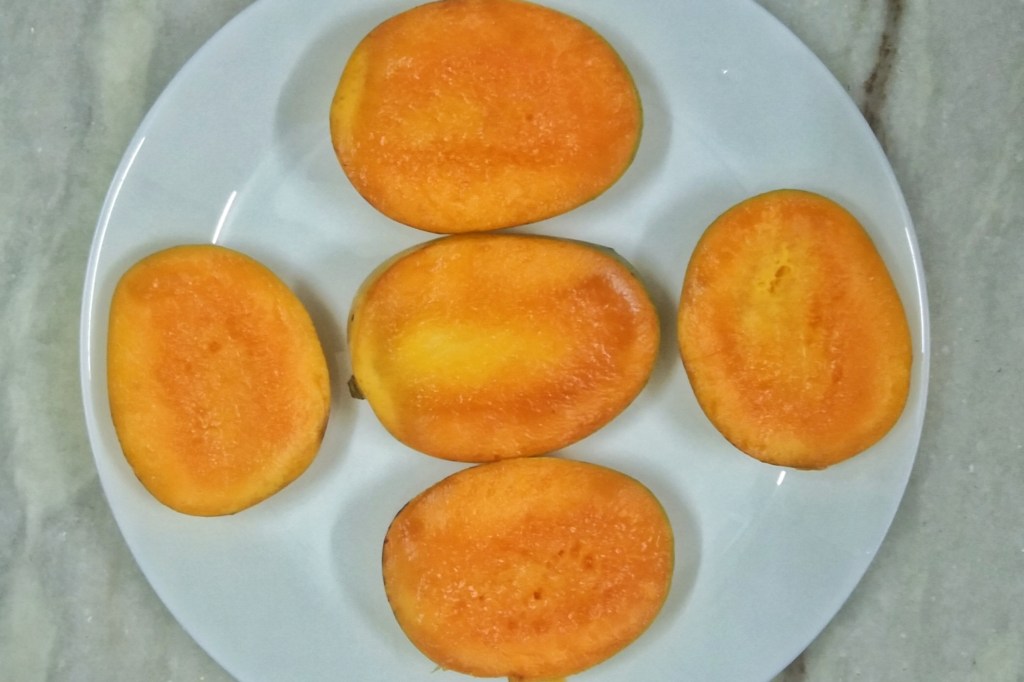
Cut Mango ready to be feasted on

The mango saplings would grow naturally in my place where the seed would germinate under the ground. We would rub a side of those seeds and open them up. Then blowing air into the opening, we made the seeds whistle tunefully.

Coming back to the present, the mangoes are available in so many mind-boggling varieties – in so many sizes, shapes and colours. The sizes can be small or medium or big; taste can be sweet or sour even when ripe; and pulp can fibrous or fleshy. Commercial varieties like Langra or Alphonso are grown in orchards in huge quantities and marketed.

In South India where I live now, we have Bigonpilli, Mallika and many more! The climate and soil have a special impact on the growth. The seeds might be sown any where but they would not quite give the taste of the original.

Mangoes are a gift of nature and a part of our rich cultural heritage. The story of feast and joy with mangoes is related to us by our grandparents and it will be told and retold as life goes on and moves from one generation to another. But there is a difference perhaps. Our grandparents told us how they planted those trees, saw them grow and finally bear fruit. The satisfaction they drew from sowing the seeds and later enjoying the fruits after many years cannot be matched simply by the relish we have by consuming them.

With more urbanization and population growth, there is less space for having a sprawling homestead with trees, ponds and gardens around. But mango trees are grown by the roads and in orchards and there is more than enough production of fruits every year. And equally phenomenal is the consumption. Let the mania continue for centuries to come.

Bulls – The Real Bahubalis (Humour)

You edge past him nervously on the road or make a detour, fearful about a sudden dash he can make towards you. But he stands there, benign and cool, perhaps thinking about what to eat for the day or where to find a new girlfriend. Be careful still – this calm might be quite deceptive.

Within a moment, he may just be doing what you feared the most and you will have no option but to run for cover. ‘Take the bull by the horn’ may be the best way to deal with beastly issues in your life but not with the beast itself. You cannot even touch his tail, let alone hold him by his horn.

Bull on the road (pc : self)

His ego is as big as mountains. He would still stand there like a malfunctioning car, bringing the traffic to a complete halt. Then as if he is magnanimous enough, he would move a bit, giving the passersby and the stranded passengers a narrow passage for making a move. It might take quite some time before he relents and clears the way.

By that time, the passersby would be restless, and buses and cars might be honking their horns to express their displeasures. But to ruffle him would be risky because if he runs amok, no one knows who might be gored and who among the crowd might be injured while trying to flee.

A bull is a bohemian in lifestyle and the way he leads his life could be the envy of even an artist. His close relatives are toiling hard in the fields, but he would eat the produce as a freeloader once the crops are ready or barge into the vegetable market and feast on nutritious food. he had no contribution in making. Thus, he would make a strong build for himself, which his  brothers and sisters can only dream of but never have in reality.

He would loaf about markets, streets or lounge in a temple complex like footloose teenagers. While the teenagers themselves would do so up to a certain age and eventually settle down and live a life of responsibility, bulls could afford to remain carefree and have romantic relationship all throughout their lives.

I had a tryst with a bull in my childhood. We grew potatoes in the  agricultural fields near our home. A bull would come regularly to eat the plants and potatoes that were still growing under the soil. Those should be quite tasty, or else why would he visit the place every day? One day, I called my friends and together we chased the bull away through agricultural fields by throwing the dry balls of soil that would be plentiful in the fields in the summer. As those dry balls crashed on his back, he ran. Once or twice he turned back, grunted, pawed at the ground and charged at us.

But that was to scare us momentarily. He would eventually go away and we would come back home, victorious. But he would return the next morning to devour our crops! Again we chased him and this continued for a few days until the bull stopped coming. Making a bull run is quite an act of bravery, I, as a 16-years old, thought then, and I patted myself on the back for it.

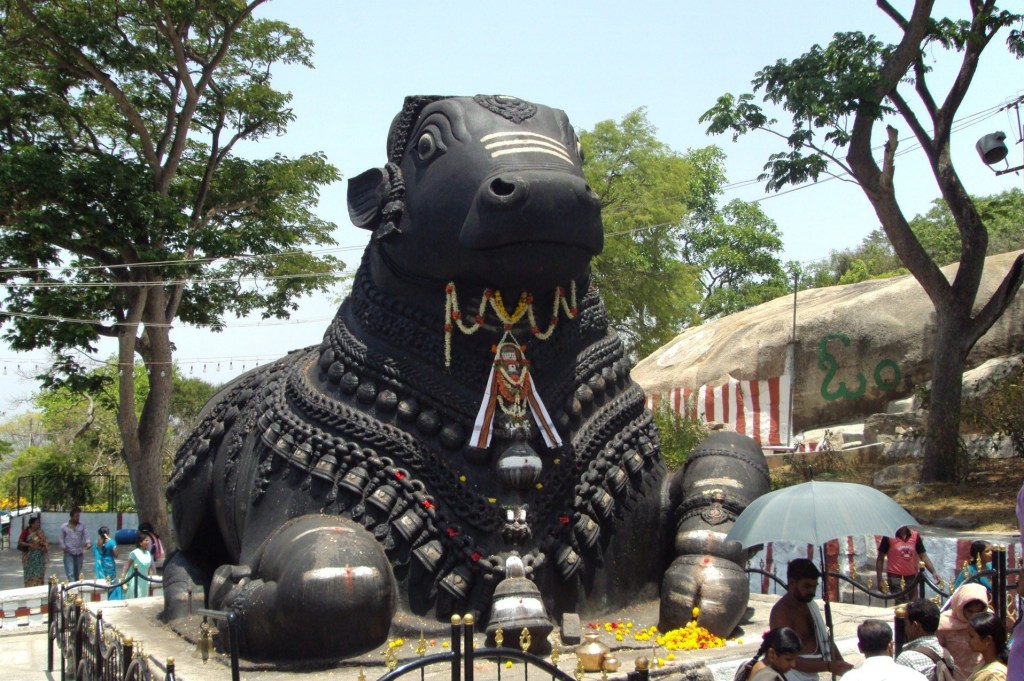
Nandi bull at Mysuru temple (pc : http://www.pixabay.com)

Their symbolic presence in the stock market is one of strength and aggression. Bulls constantly fight with bears and when they take control, stocks rally and people make money. In Hindu religion, the bull, Nandi, is the vehicle of Lord Shiva. The statues of bulls are installed in temples where they are worshipped.

There are bahubalis (strongman) among politicians who have a strong influence in their localities and make their presence felt by intimidating people around them. But ultimately, they are brought to justice and often serve terms in jails. On the other hands, bulls generally do not trouble you unless you trouble them.

Their occasional aggression is perhaps to remind you, ‘Don’t mess up with me. My horns are enough to toss you up like toys and shake your whole make-up.’ Their mere presence sends shivers down your spine and you keep distance. They build a strong physique and live lives on their own terms. They are the real bahubalis of India.

Inspiration

A kite was gliding
In the sky;
A boy stood imagining
One day he would fly
Under the blue sky,
Over the mountains,
Over the oceans.

Far into East and West
Into North and South
Nothing stopping him
Feeling the air currents
Pleasant and cool
Flowing over his wings.

pic credit (www.pixabay.com)

A bearded man
Picked up brush and paint;
He sketched the kite
Silhouetted against the sun;
He drew a cage
With a bird inside
Looking for release,
Tears streaming down her eyes.

An urchin giggled,
With a bread in hand,
And hairs tousled,
Two crows hovered around
To swoop down
And take up the prize

A pair of searching eyes
Looking through lens all times
Saw them.
And clicked images
Poignant and sharp,
Depicting
A mix of pleasure and pain.

Day wore on and poured into night
Birds returned to their nests singing;
A man crazy about picking
Music from every happening
Heard the birds’ communes;
He composed his jingle
Mingling rhythm with tunes.

The moon shone that night,
Bright and beautiful,
Wolves howled, lovers met,
Romantic and joyful.

A man sat in the open
With paper and pen
Waking all night watching;
Lyrics were born
Extolling
The moon and the shine
And the joy flowing down.

Inspiration comes
Percolating in tiny trickles
Enlivening the spirit,
Loosening the mind
In magical effect
Into making newer things
Indulging in the beauty of creation.

I’m A Magician

I’m a magician,
No wand, no potion;
Just with lotion
I do magic
And make myself shine.

Representative Image (Picture Credit: http://www.unsplash.com)

When mind is dark
And life loses its spark,
A candle
I light;
All darkness is gone;
Soul is filled with light
And mind strong and bright.

When body goes slow
And life loses its flow,
I lift myself with song and dance:
These two legs
I shake,
Mind is filled with joy
And body sprightly and gay.

When knots tie me down
And things are long drawn,
I hold the knots
And pull the rope,
They are put aside;
And the wheel
Starts turning again.

When doubts nag
And fears cripple me;
A big broom
I take
And sweep the fears away
And leave doubts no room.

I can be hurt with thousand cuts,
Yet I come back to life unhurt
With greater strength
Greater vigour
I can make my joys appear
And sorrows vanish in no time.

Throw me into ocean
Of darkness, shackled
I break free
And come ashore
World welcomes me back again.

Throw me into fire,
I burn to death;
Yet I rise
Like a phoenix
From the ashes
Alive and strong.

I’m a magician
I can do anything and everything.

(Inspired by lessons from Law of Attraction coach Mitesh Khatri)

Remembering Two Mothers

My mother and mother-in-law have both left this world. When they were alive, they took great care of the family, home and the people around them. The simplicity of their lives, extraordinary courage, spirit of service and sacrifice humble me and keep me always down to earth. They were in some ways similar and some ways very different from each other.

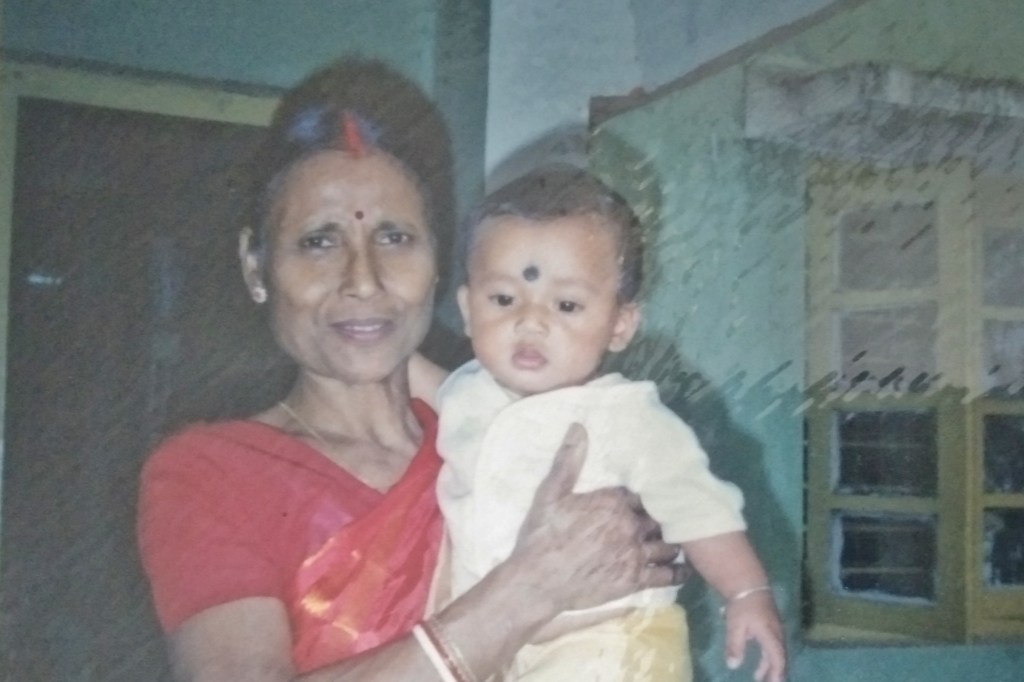
My mother, Ranjita Ray, with grandson

Born in villages, they grew up in a way of life that has to deal with on a daily basis people, agricultural produce, village gods, livestock and nature. My mother’s birthplace is Shakhariyapara in Coochbehar district of West Bengal – a hamlet with families living closely together with agricultural lands producing crops, ponds abundant with fish, and milch cows and buffaloes giving bucketful of milk. Simplicity is naturally bred in people who live with small ambition of growing crops sufficient to feed the family throughout the year, of building a house that would withstand the vagaries of weather and of educating children for finding a job. My mother bragged about fish and milk that she had enough of in her childhood.

My mother-in-law was born in Goalpara district of Assam. I visited the place only twice. It is a prosperous village in the floodplains of river, Brahmaputra, where people have abundance of agricultural produce and are culturally inclined towards song and dance.

After marriage, my mother moved to another village and my mother-in-law to the district town of Jalpaiguri.

My mother was a perfect homemaker. She kept our home and the surroundings absolutely clean. She would not allow fallen leaves to lie on the ground or dust to gather in furnitures, utensils or the floors of the house. With a broom, she would keep sweeping them away from time to time. She was well versed in puja (offering) to village gods and celebrations of religious festivals, harvesting season and all that. The rituals needed special knowledge and skills for which my mother was sought after by womenfolk in the village.

My mother taught me ABCD and taught me to be simple and honest. She took great care of me whenever I fell ill, nursing me waking sometimes the whole night. She brought up her two children – my elder sister and I – in this manner.

Mother-in-law, Purnaprava Barman, with grandchildren

My mother-in-law was a progressive woman who pursued her studies on law and her passions even after marriage. She later joined politics and fought many electoral battles and served people as municipal commissioner. She was also a matchmaker who took great interest in finding matches for marriageable boys and girls.

A trait shared in common by my mother and mother-in-law was, however, their penchant for inviting people for lunch or dinner.
Mother-in-law could make some very special cuisines and she would rustle up something for guests as soon as they arrived. Another trait of them was their expertise in home remedies for fever, cough and other ailments.

My mother-in-law was interested in literature and wrote poems in Bengali and Assamese and got them published. It is in this aspect that I had a special bond with her.

The lives of both mothers were lessons in service and humility. Their selfless service to family and all people connected with their lives without personal ambitions humble me. I have built my home in a big city. Here ambition, selfishness, greed, loads of aspirations and race for success suppress happiness, naturalness and simplicity of life. People do not have time to think about others. When I get swayed by ambition and greed, I take comfort from the fact that there is also a way to live devoid of all this and live a fulfilling life. The path shown by two mothers!

Walking by the Sea

The swish of waves
And the blast of winds;
The roar of the tides
And rhythm of their strikes;
Restless and loud,
I hear them,
Walking by the sea
From sunrise to sunset.

Representative Image (Picture Credit: http://www.unsplash.com)

These bursts of joy,
Even I do have;
But they only bubble
And fade away in ripples;
Too little before her
As she goes on, relentless
And seeks no rest.

Far into the sea,
Though deep and calm,
In those blue waters,
Hurricanes and Cyclones form;
I feel them,
Walking by the sea;
Dashing and smashing,
They would one day
Come and hit you and me.

Fury of this kind,
Even I do have;
But not that fierce
Thankfully,
Even to rattle a mouse
Lasts not long enough
To harm my house.

From east to west,
So vast a spread;
Continents are just islands,
In her endless breadth;
And deep into her womb
There are many secrets.

The depth of my mind,
Even I do try
To meditate and explore;
I reach almost the end of it,
But I dare not measure her,
As she stretches my imagination
Beyond limit.

On the shore,
I walk
To leave my mark
On the sands of time
That I existed once
To admire her trance.
But waves come in
And erase them
In no time.

But I will one day be
A speck in the sand,
A whoosh of wind
Blowing in the beach;
My promise!
Formless, timeless,
I will one day be
A part of the sea.

Durgapuja – A Celebration of Creativity

Durgapuja, the grand festival of Bengal, is around the corner. It is a yearly event, but the build-up of excitement starts not just a few days before the festivities but right after the end of previous year’s celebration, culminating in the four days of puja. The event has a few parallels in the world. Recently ‘Durga Puja in Kolkata’ has found place in UNESCO’s Representative List of the Intangible Cultural Heritage of Humanity.

Durgapuja at my hometown, Maynaguri

I have very fond memories of new dress, pandal hopping and special food especially in my childhood which is the best time to enjoy any celebration. But what makes me marvel at is the enormity of creative energy that is unlocked by the celebration.

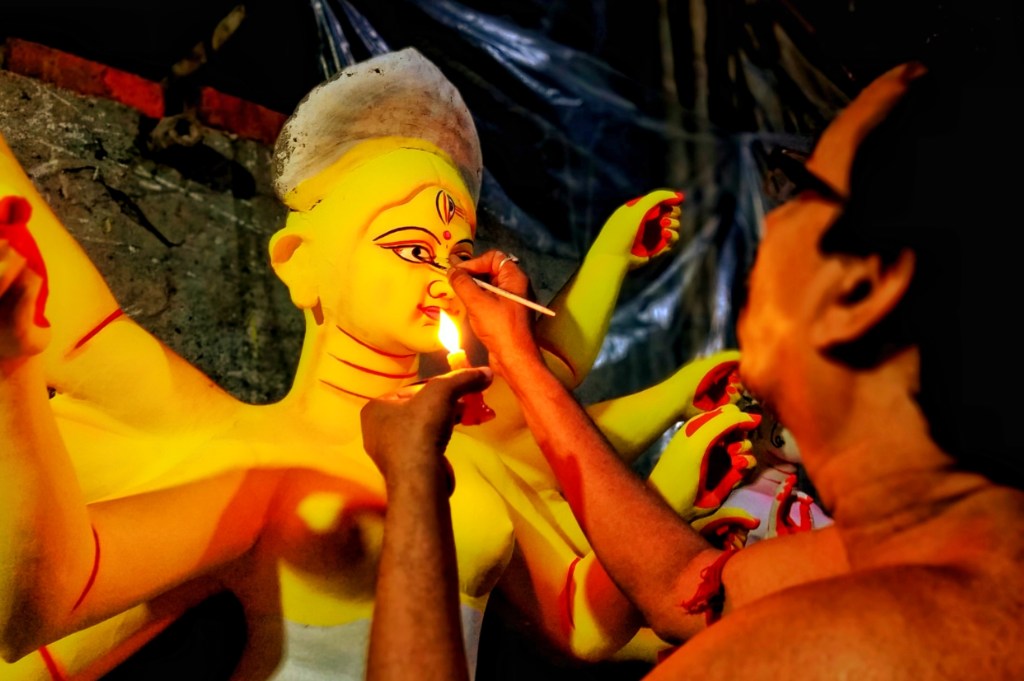
Firstly, the clay idol of the goddess Durga itself is made by idol makers with such dexterity, making it always look different from their old work or those of others. Then the pandals are decorated with colourful clothes, but often artists come up with innovative ideas and spring surprises by using materials such as jute, waste bottles, glass, paper and wood. They also base them maybe on themes such as current events, history and environment, to carry important message to the people.

The streets are festooned with lights with special patterns, creating a delightful panorama for the visitors as they push their way through the crowd up to the pandals. The competition between clubs that organize the mass celebration only improves the quality year after year as they try to outdo each other in grabbing attention of the public and having footfalls at their venues.

Publishers bring out special editions of magazines with more stories, novels and poems. The writers seem to save their best writings for the puja editions when they can reach the maximum readers and audience. The Bengalis are avid readers and make their budget for buying the puja editions.

Artist giving final touch to Durga idol (image courtesy:. http://www.unsplash.com

Similarly music is composed especially keeping in mind the celebrations and albums are released as music lovers eagerly look forward to them throughout the year. I relish the new stories and music at this time year after year.

Another aspect of it is adda (Bengali equivalent of long conversation by a group). The unadulterated adda goes on before, during and even after puja at homes and pandals, and Bengalis engage in conversation with near and dear ones about life, culture, achievements and their joys and sorrows. People who live away from family for livelihood return home to take part in the celebrations.

I am not a good conversationalist, but I do take part in the adda for exchange of notes, fun and also for reconnecting with friends and relatives whom I might be meeting perhaps after a long time.

Durgapuja is close to the hearts of the Bengalis. It is a time for renewal, a time to soak in the festivities greatly enriched by a huge amount of painstaking creative work. Autumn, the season, gives nature a facelift during the puja. The flowers that bloom and the dew on the grass and the clear blue sky are the signatures of the season. Together they act as the perfect foil for the colourful celebration of Durgapuja.

Bliss

Oh, my friend,
Stow away your gifts ,
In your cosy niche;
Let not daily grinds
Rob your bliss.

Up there
Have a slice of the sky;
Away from the dark cloud
Let your kite fly;
It must have
A way to glide;
Let not a storm
Rattle its flight.

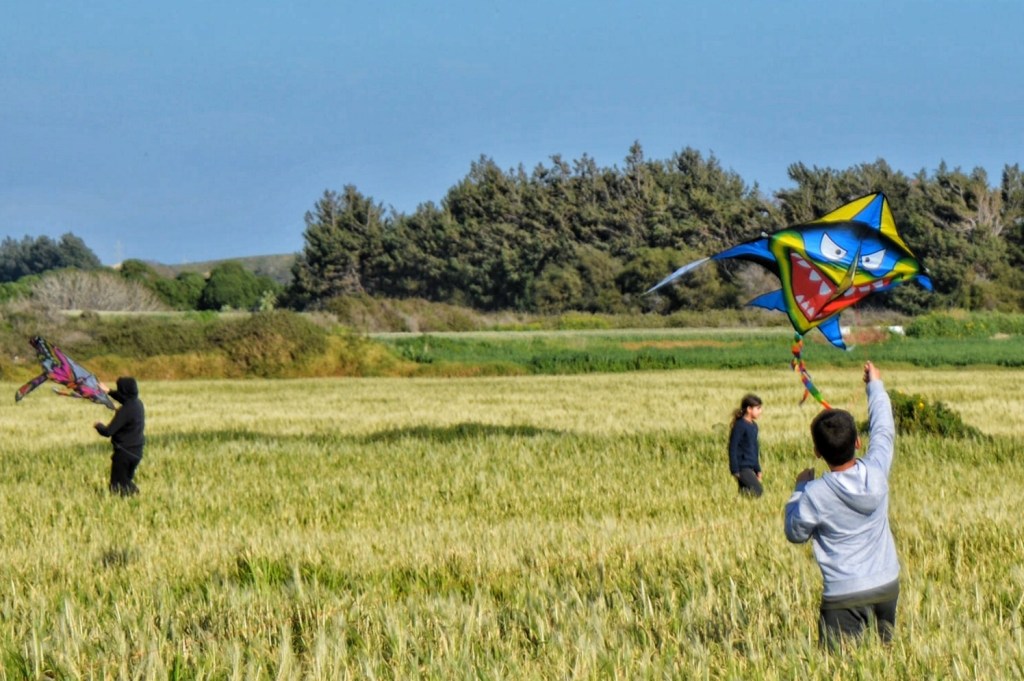
Flying Kites (Image Credit: http://www.unsplash.com)

Have your little pool
In the ocean,
Bathe in its water,
Let your joys flow;
Let not the wild currents
Wash away the ripples;
And let not the weeds grow.

Sing with joy,
Dance with rhythm!
Let not the din
Drown your song;
Let not your feet
Get the beats wrong.

Climb up or fall!
Listen to the birds
Chirping in the trees;
See the waterfalls
Dancing in the hills;
And look at the pebbles
Sparkling in the river
Before it meets the sea.

See all around,
Make them your part,
And love all
That make up your earth.
Let not life
Move away from its path.

Good Times in Life (Musings)

I have spent over half of my life. Age is not only a taker but also a giver. It takes away our vitality but leaves us with the gift of experiences and realizations that only mature as years pass by.

The journey of life is our own but is made together with family, friends, relatives and colleagues. We seek happiness, joy and satisfaction in our personal, social and professional lives, but good times when life seems to sway with particular rhyme and rhythm come occasionally and are short lived.

Good Times – representative image (Image Credit: http://www.unsplash.com)

The phase of life we are in has a role in the making of these good times. We cannot remember the period of our infancy. However, our childhood and school and college life are the times when friendship happens effortlessly, and games, fun, frolic and entertainment that follow make them so enjoyable and exciting. Our natural curiosity at that age gives us a sense of discovery as we learn things and know the world we live in. 

After college life, it is quite a struggle to establish ourselves in life. We are lone rangers in looking for jobs or other livelihood to satisfy our needs. The struggle makes us face some harsh realities not experienced in student life.

Then when we become parents, growing children fill our lives with unbound joy and happiness. A family perhaps spends its best time when all three generations –  the grandparents, parents and children – are around.

In professional spheres, teamwork yields salutary outcome, when team gains its rhyme and rhythm in the way of working. Like in orchestra where all instruments have to be in sync to create music, team members have to work with clear understanding of their roles and coordination to produce outstanding results. But such times when a team is built that works in perfect harmony and delivers best results may be rare.

A nation also has its share of good times in its long life. In India, remarkable progress was made in nation building and outstanding work was done in literature, art, science, music, cinema before and after independence. People with talent were born in that period and they produced work that had a long lasting impact on the economic, social and cultural lives of the people of India. Even with technology available now, we are not able to touch the height they reached without much resources at that time.

Good times do come and go, and we need to have the patience to wait for them. But when they come, we need to make the most of them. They leave great dividends and also memories which give us the mileage to move on with the rest of our lives.