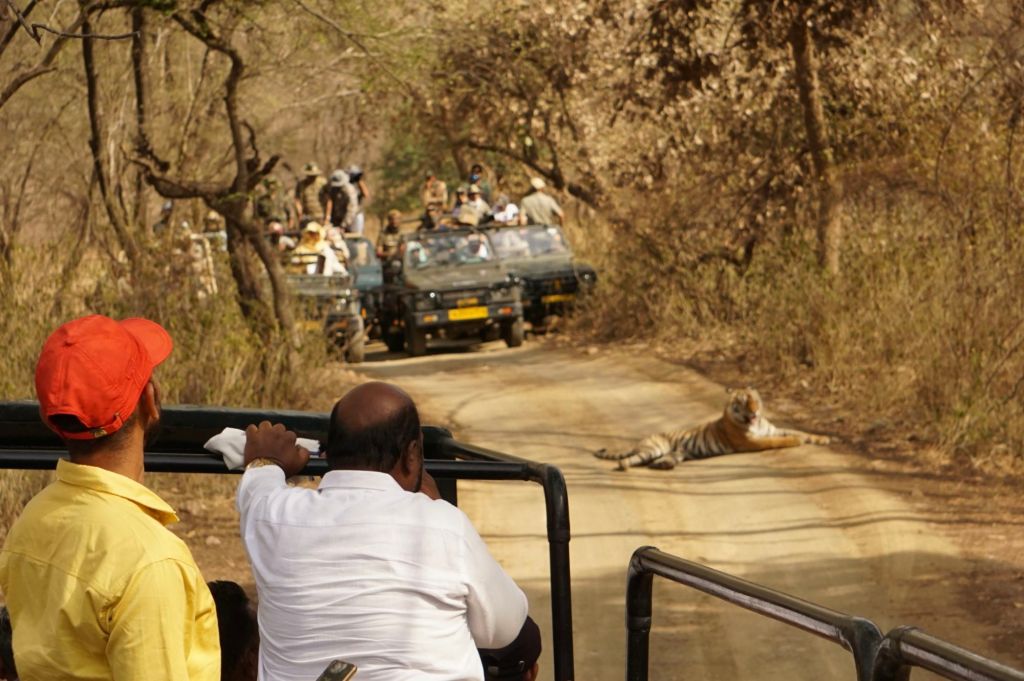
In a forest, tigers are only expected to be beside the trees, in the meadows, caves or maybe in and around water bodies, and tourists have to widen their eyes a bit to discover the big cats in the inner recesses of the forest. And the sighting happens only occasionally. So when on my last safari into the Ranthambhore Tiger Reserve, the safari canter carrying us, the tourists, bumped into a tiger resting on the route, it was a reward beyond expectations!
Ranthambore Zone 2
At Ranthambhore Tiger Reserve, the part of the forest open to tourism is divided into five zones: zones 1, 2, 3, 4 and 5. It was on a hot afternoon of April that our safari canter entered the zone 2 and had to stop, seeing other tourist vehicles stranded there. A young tiger stretched itself in the middle of the road and was in no mood to leave. I brought out my camera, clicked just enough photos for remembrance and was done with it. So did the other tourists as the tiger turned to its left and to its right and then towards us to have a good look at the tourists.
The tiger looking at the tourists
Half an hour had passed and we had the rest of the zone 2 to see within four hours of the evening safari. But the tiger kept us guessing about how long it would be lying on the road. The tiger seemed to assert that we were in his territory and he would move as and when he pleased! The tourists kept quiet, waiting for the tiger to clear the road at its own sweet will.
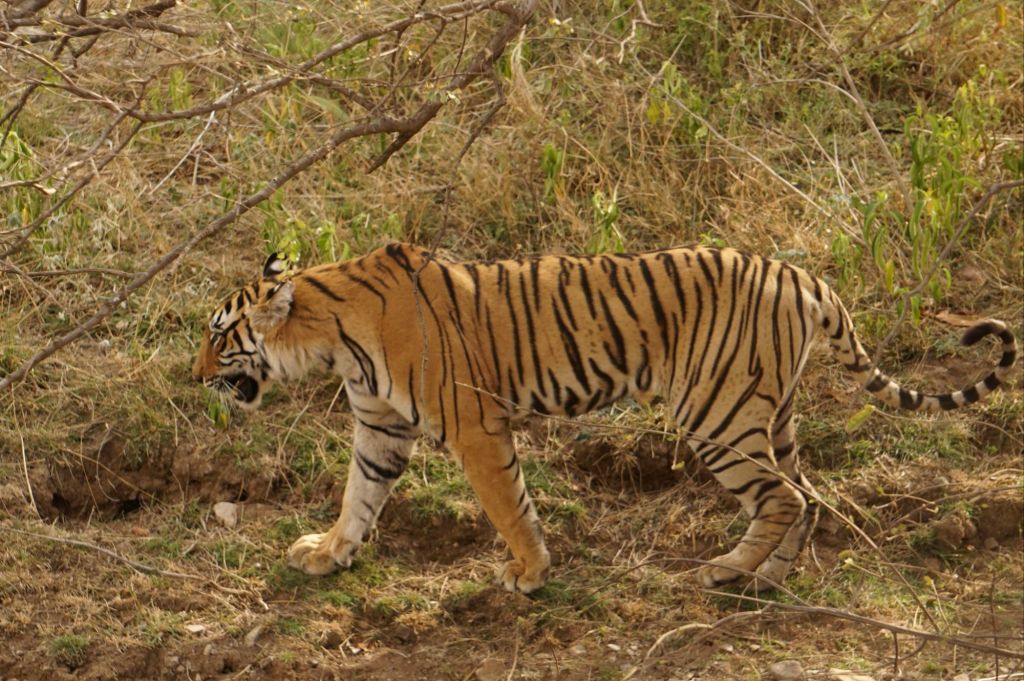
It was almost after an hour that the tiger rose from the ground and walked down in lazy steps to a waterhole nearby and sat on the water to cool itself.
Tiger walking down to a waterhole
Being nocturnal, tigers spend most of the day, sleeping or resting in the shades after ensuring that no one from their own community was encroaching on their territories. No worries as others pose no threats to them. The tiger chose the comfort of soft sand of a safari route for a siesta perhaps after a heavy lunch. But it was all good for us, the tourists, or else we would have had to strain our eyes looking into the forest and having only a glimpse or more often return home disappointed without sighting any one of them. We were so ecstatic and thankful!
Away from the human world, sheltering a wide diversity of species in their inner recesses, forests inspire unbound human imagination, wonder and curiosity. People flock to the jungles to explore the sights and sounds of nature’s wonderful creations – seeing a lion or a tiger roam in the wild, hearing their roars or listening to the songs of birds can be the experience of a lifetime.
I was at Bandhavgarh Tiger Reserve in central India in January this year. It was on a cold morning that I reached Umaria, which is the nearest railway station to the reserve, and took a bus to Bandhavgarh. The road from Umaria cuts through the forest and leads to Tala, a quaint little town at the other end, where the tourism offices and safari zones are located. As the road stretches ahead, the town widens and accommodates the lodges and resorts for the tourists right up to the edge of the jungle.
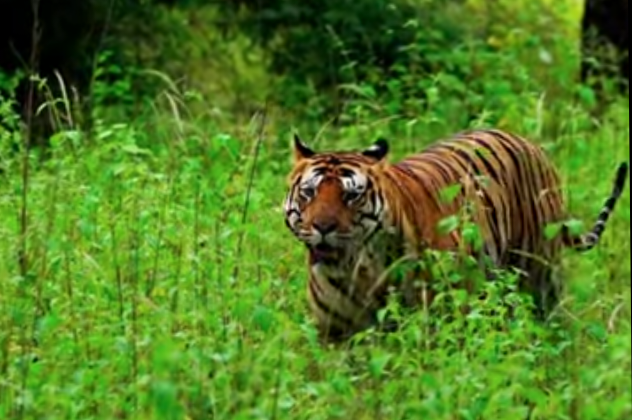
Bajarang the tiger (from MP tourism YT video)
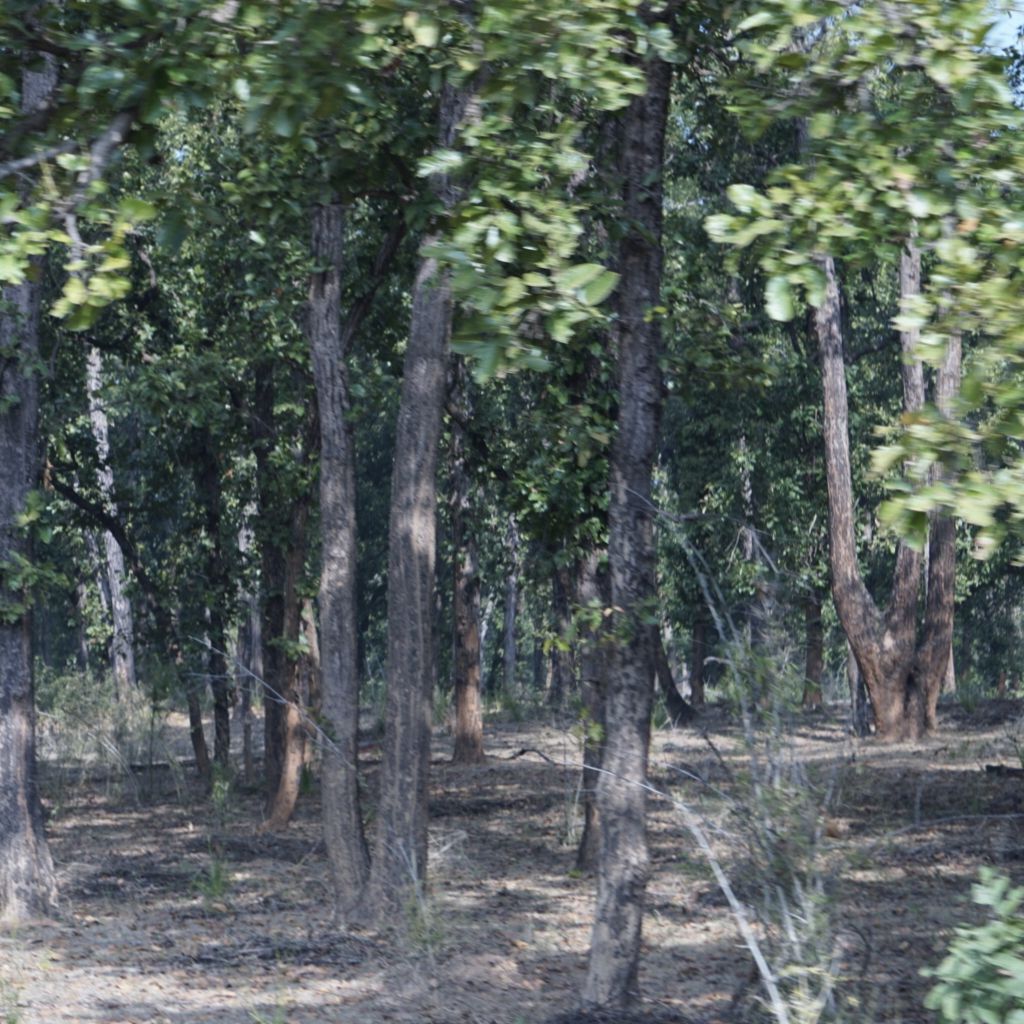
Staying at Tala for two nights, I made three safaris into the core tiger zones of Tala and Maghadhi. Bandhavgarh is a lush forest of sal, teak, bamboo, peepal and other varieties of trees, interspersed with wide open grasslands. The forest starts from the edge of the town, hardly one and a half kilometres away from where lives a large male tiger, Bajarang. On day one, the safari jeep took me and my fellow passenger, Benzamin, through the entry gate into the undulating landscape of Tala Zone.
The vehicle went gliding up and down the wavy road and soon we were into the territory of tiger Bajarang. There are about 135 tigers at Bandhavgarh according to the census by the National Tiger Conservation Authority and only those along the safari routes are affectionately named by the forest department. The guide showed us the deep scratches the tiger made on the trunk of a tree to mark his territory. Tigers establish their territories to secure the supply of food, and every tiger has a kingdom of his or her own. We drove through Bajarang’s territory, but the tiger did not show up. His area is spread far and wide from the safari route – understandably, he was on the prowl for a kill or resting in a cave or courting a tigress.
Safari jeeps with tourists, many of whom were foreigners, were zipping to and fro, looking for the majestic animal. Had the tigers known of this craze, perhaps they would have done catwalks before every safari jeep and become ultimate style icons! But the royals are their own selves, wild, elusive and uncaring of any human attention.
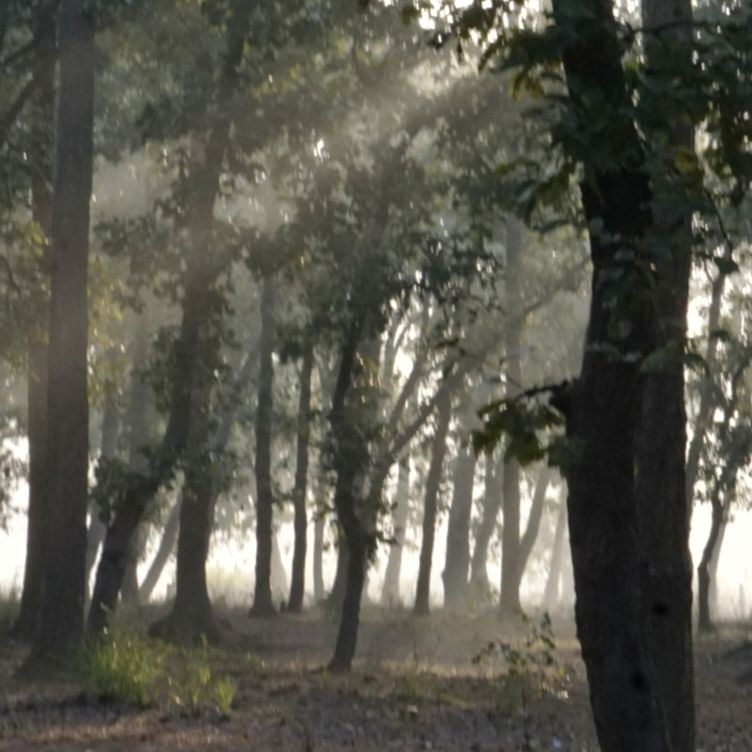
The jungle in the morning (captured in my camera)
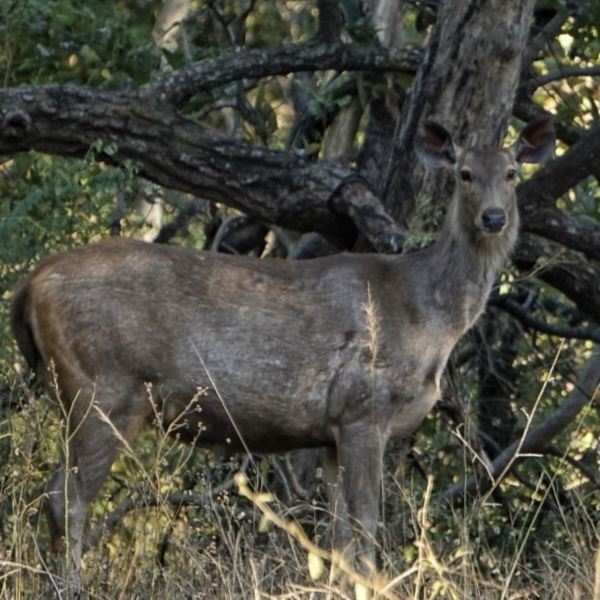
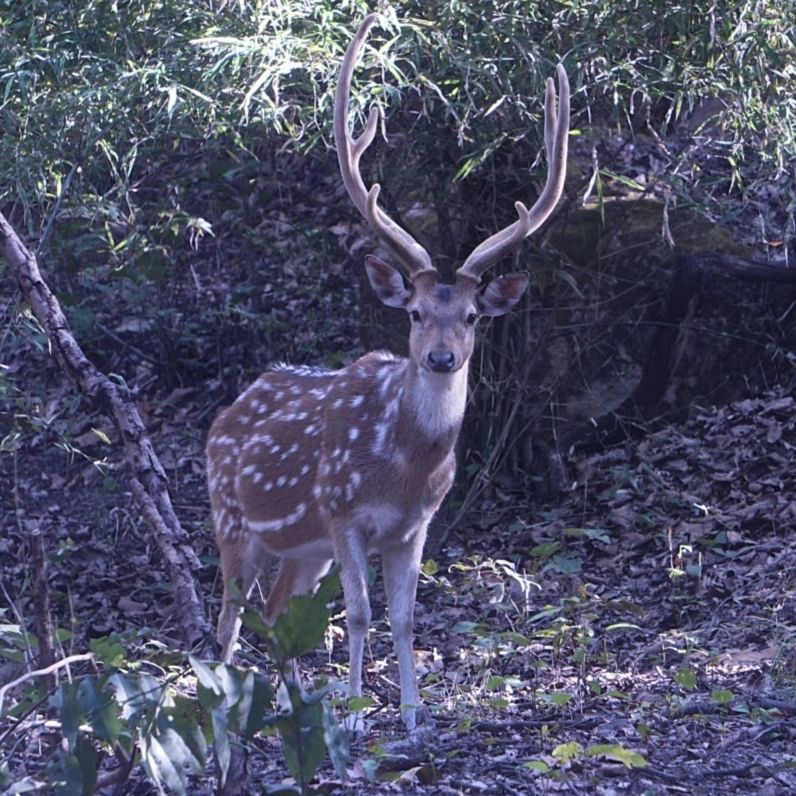
On the way further, however, spotted deer (chital), sambhar and bisons were slaking their thirsts in the streams while some stood looking at us quizzically, their ears upright. Thankfully, their abundance ensures that the tiger Bajarang, staying so close, is no threat to the humans in Tala Town.
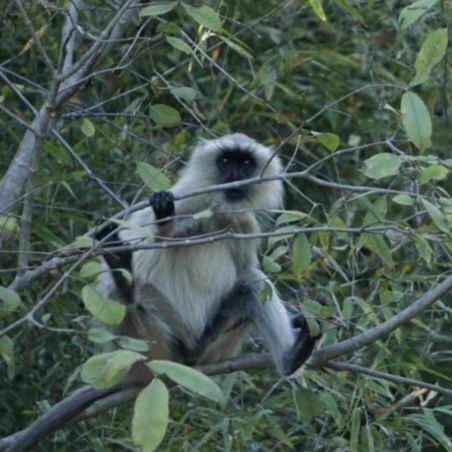
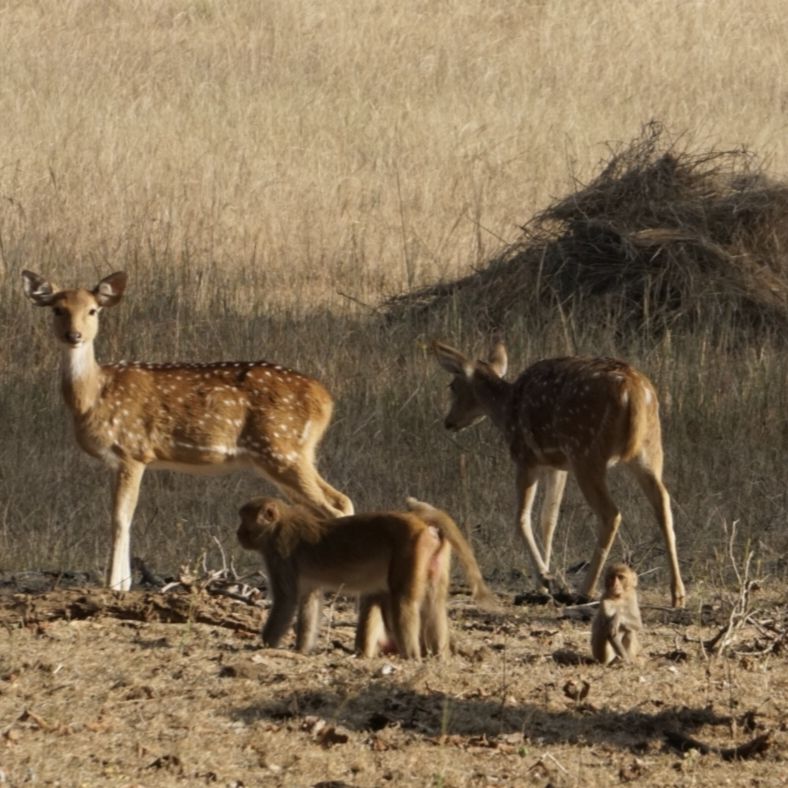
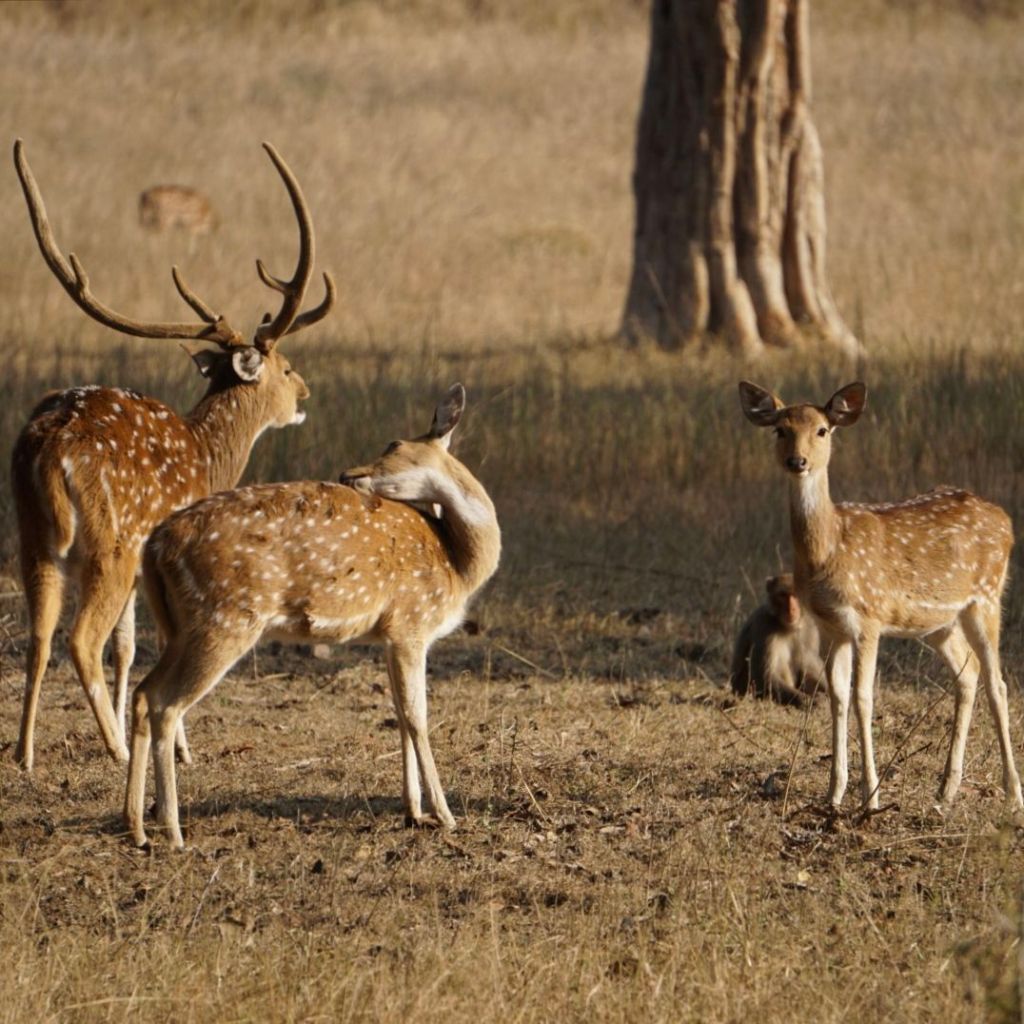
Monkeys hung from the branches of trees as usual – they are the ones who shuttle seamlessly between human habitat and the wild! Extremely agile, intelligent and athletic, they can climb to safety at the slightest hint of trouble and make fools of both humans and tigers! Being vigilant, however, while in the jungle, they partner with the deer and roam together, alerting each other of the movement of predators.
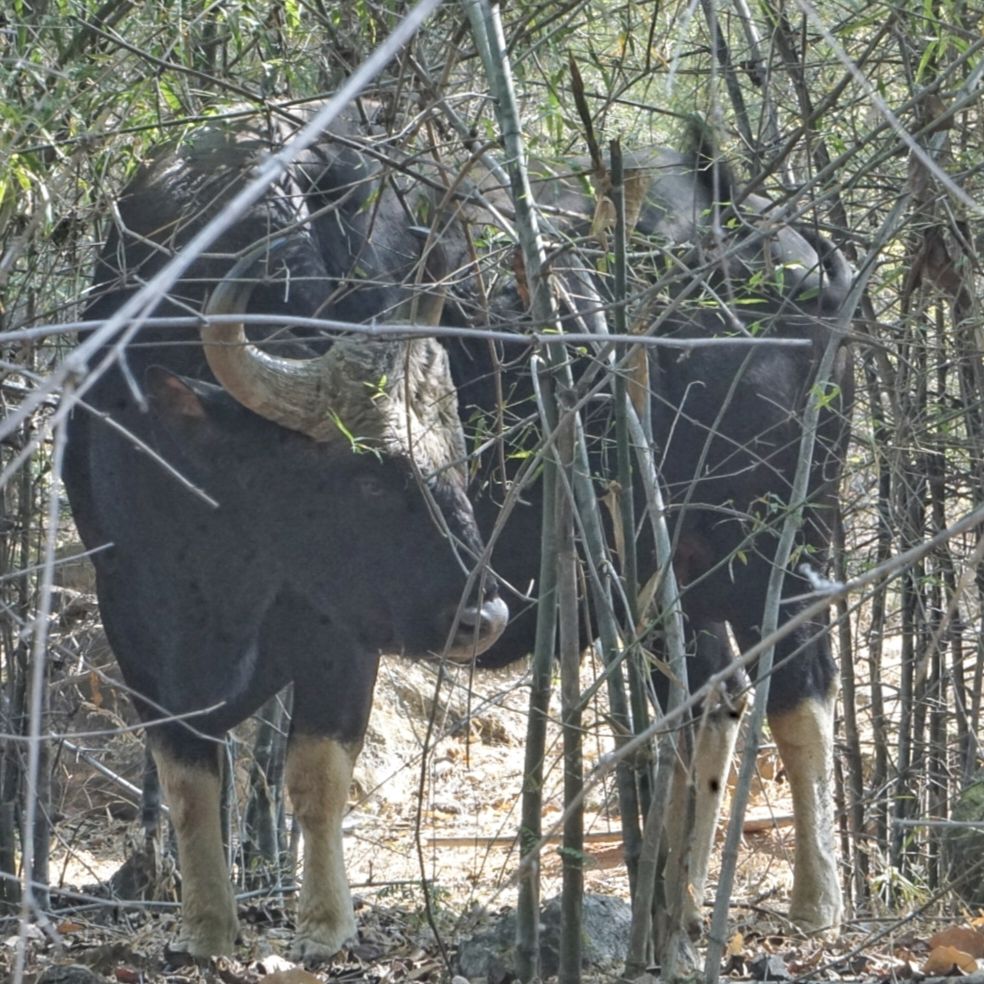
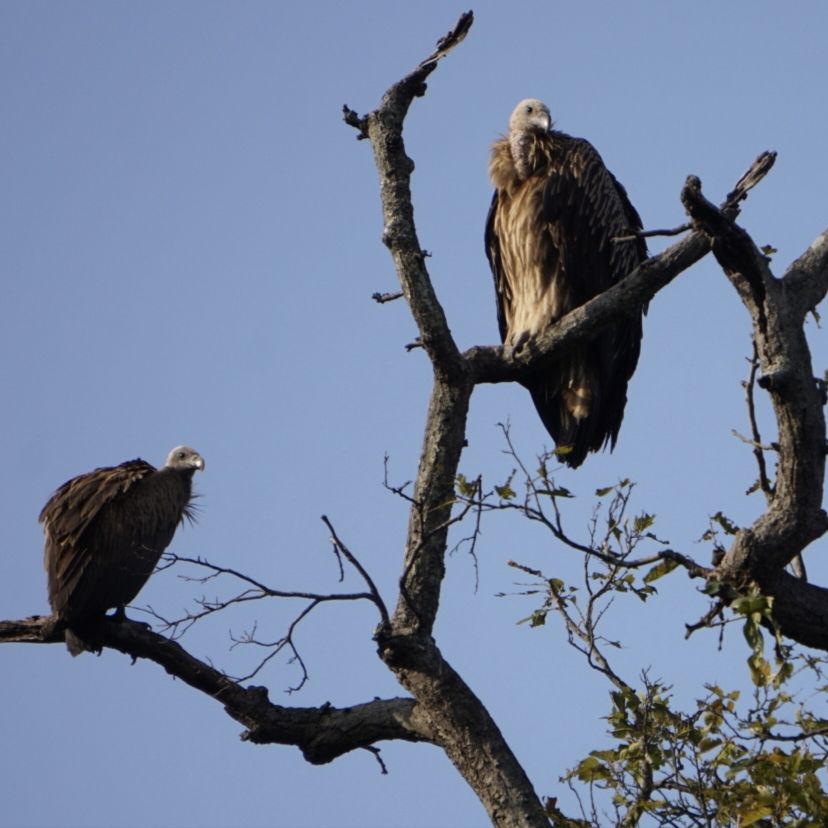
Animals roamed free and uninhibited – a jungle fowl behind a bamboo thicket, a spotted owl nesting in a tree hole, a malabar hornbill on the top of a tree, a jackal suddenly appearing and slinking away and a bison calmly feeding on leaves of a tree perhaps feeling a little safer because of its size. Two vultures perched on the top of a tree and from their lofty vantage point must be looking for the carcasses of animals to feed on.
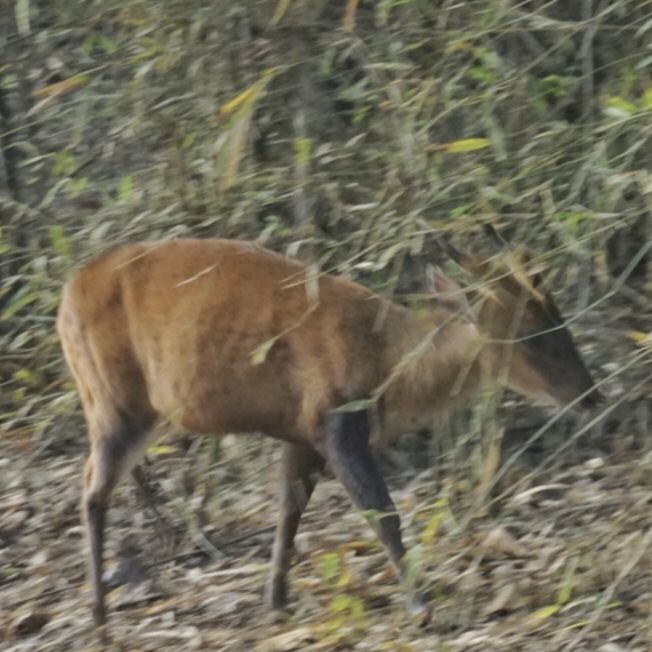
Sambhar, Bison, Barking Deer, Vultures (captured in my camera)
The jungle has undergrowth in parts and only a cover of grass elsewhere under the woods. And deep inside, there is a lake and beside it meadows of elephant grass where herbivores graze and tigers hunt by ambush.
January was unusually cold this year. On day two, again at Tala Zone, the morning was misty, reducing the visibility, but once the mist cleared, sunlight passed through the gaps between the trees. The safari jeep was ascending the hills in Tala Zone and on the ascent, we viewed the entire canopy of the jungle and also found stables for horses. Humans are no strangers, after all, to the tigers of the forest, the only difference being that earlier they roamed on horseback and now on safari jeeps.
The vehicle took us up to Sesh Saiya, which is a reclining carved statue of Lord Vishnu at the top of the hill. Bandhavgarh Fort, which is now abandoned, was within a short distance but the entry to it was prohibited. The fort was built about 2000 years ago on the top of the hills, giving the king’s army the advantage of the height as also the cover of forest roamed by deadly beasts. The jungle derived its name from the fort.
Monkey – Deer friendship (captured in my camera)
India is a land of tigers, and the kings of the good old days have had a strange relationship with the kings of jungles. Hunting expeditions by the rajas (kings) and at the same time the conservation of the species are part of folklore in India.
My last safari was to the Maghadhi zone a little far from the Tala Office. This part of the forest is in plains unlike the hilly Tala Zone. Early in the morning, call of barking deer was heard very prominently and safari jeeps rushed to the spot, but no tiger could be sighted. Blue bulls (Nilgai) were grazing far away and a sounder of wild boars went, grunting along the way as usual. Tiger’s pugmarks were found in the safari routes, indicating their overwhelming presence in the forest. It is only a matter of chance that the tourist vehicle passes by exactly at the time the tiger roams near the safari route.
Apart from having an intense wildlife experience, I had the pleasure of meeting tourists and wildlife enthusiasts from around the world. I met on my safari rides Benzamin, a French national, and a Spanish couple, who came to Bandhavgarh, after visiting Kanha Tiger Reserve. Two Bengali families from my home state West Bengal accompanied me into the forest and then were off to Kanha and Pench Tiger Reserves. Their wanderlust was refreshing, and meeting them only pushed my enthusiasm for wildlife up a few notches. I did not spot a tiger this time – hopefully my wish will be fulfilled in my next visit to another forest.
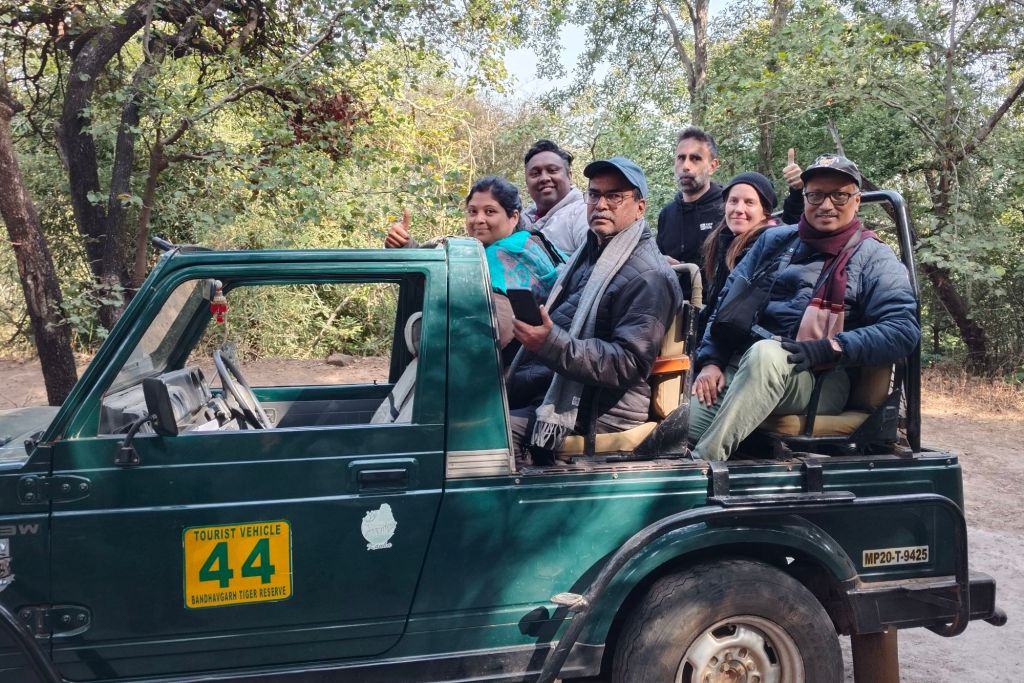
Our Safari Jeep
Teashops, souvenir shops and cloth stores were on both sides of the road in Tala Town, and the artefacts, painting and clothes being sold were all about tigers. The shopowners and taxi-drivers with whom I interacted were supportive of wildlife, emphasizing that tigers had caused no harm to them even when they were occasionally out of the forest.
A forest has a huge significance for the environment, wildlife, history, economy, tribal life, tourism and literature, and can be looked at with as many perspectives. As a tourist and a wildlife enthusiast concerned about environment, however, I was happy to find all these resonating well through the wild terrains of Bandhavgarh.
Nature beckons us, and for me, it is the mountains that have held an irresistible charm since my childhood. I was born and brought up in the Dooars region of West Bengal which is the door or the entry to the North Eastern part of India. The Himalayas are to the north of Dooars, and on a morning of clear blue sky, one can see the mountains standing silhouetted far away in the horizon, stretching from the east to the west. When capped with snow, the peaks look resplendent in the morning sunshine.
My father was posted in the hill stations of Kalimpong for some time and then Karseung and Darjeeling in those years. I could not really imagine how and where those hill stations were nestling at that high altitude of those mountains.
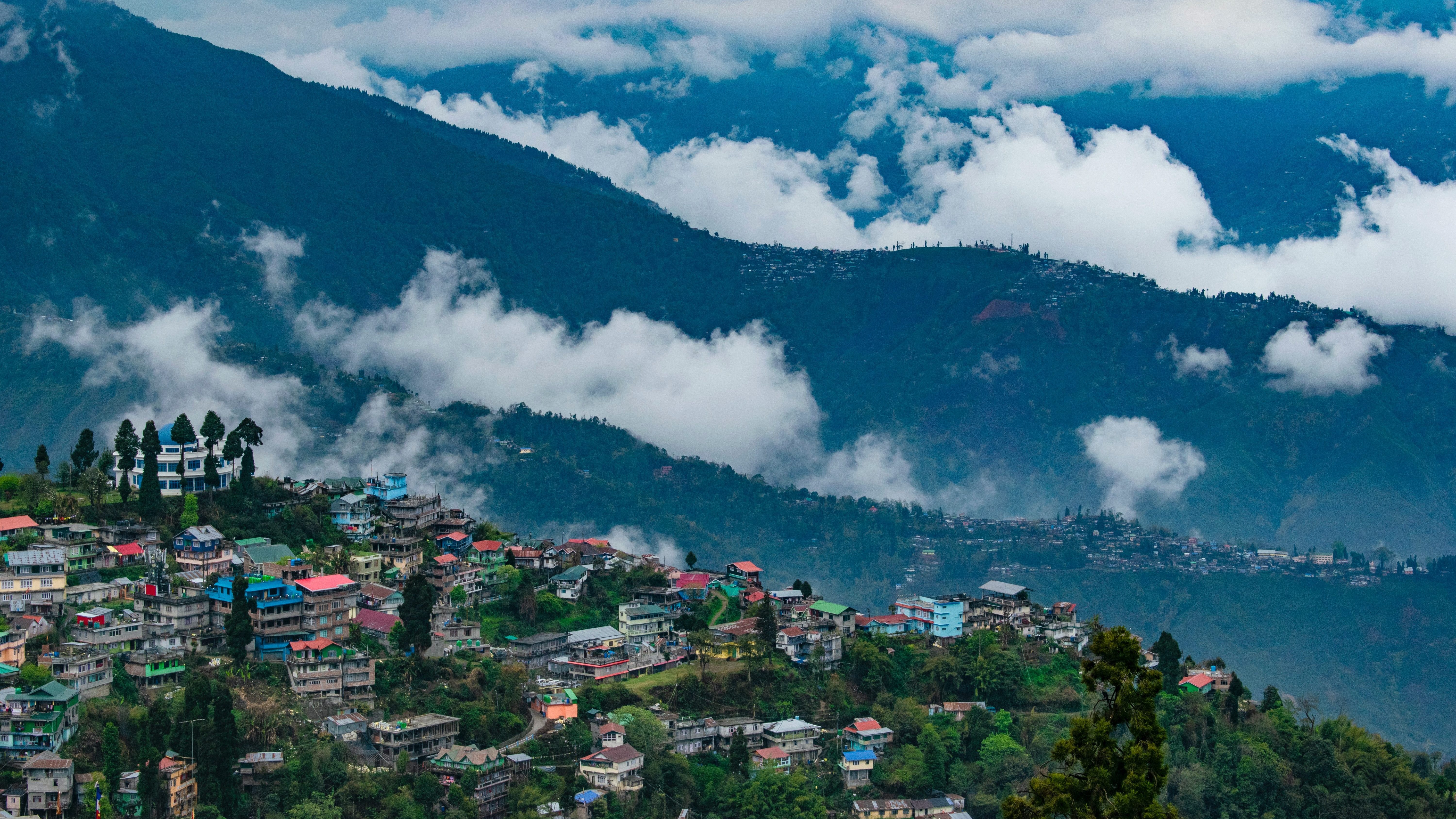
So I had discovery of sorts when my father took my mother, sister and me on a trip to Darjeeling. I have vivid memories of that trip. From Silliguri the journey to Darjeeling by bus is through curvy roads, sharp bends, U-turns by the flank of the hills. The dizzy heights of the hills filled me with wonder and consternation. Sitting in the bus though, I had wonderful view of tea gardens and forest of eucalyptus, deodar and pines in the slopes of the hills.
It was in a winter of biting cold that we went to Darjeeling, carrying a luggage of warm garments – sweaters, woollen caps, etc. We put up in a house where my father stayed along with his colleagues. I told them that I would one day build my house there by carving the hills. We had a great fun with uncles who were greatly amused by this ambition of mine.
Afterwards, I made trips to other hill stations like Nainital and Ranikhet of Uttaranchal. The quaint lakes – Naini tal, Bhim tal, Saat tal, Naukuchia tal – at Nainital surprised me by their very existence at the high altitude of the mountains. Then there was that grassland at Ranikhet, which is ideal for film shoot and I watched dances of heroes and heroines in many popular Hindi movies shot in that location.
Every hill station has a history. Many of them were developed by the British who had retreat in the comfort of pleasant weather and scenic beauty of the hills. Many Englishmen made these hills their homes and stayed on even after the British left India.
My favourite writer, Ruskin Bond, lives in the hills. His writing familiarises me with life in the hills and with people, animals, birds and trees especially at Dehradun and Musoorie. No other writer explored life in the hills better than Ruskin. Rusty and his characters’ hill adventures are a great read for the kids. The scenic beauty, sound and light and people’s lives in the hills are nowhere else so prominent as they are in his stories and novels.
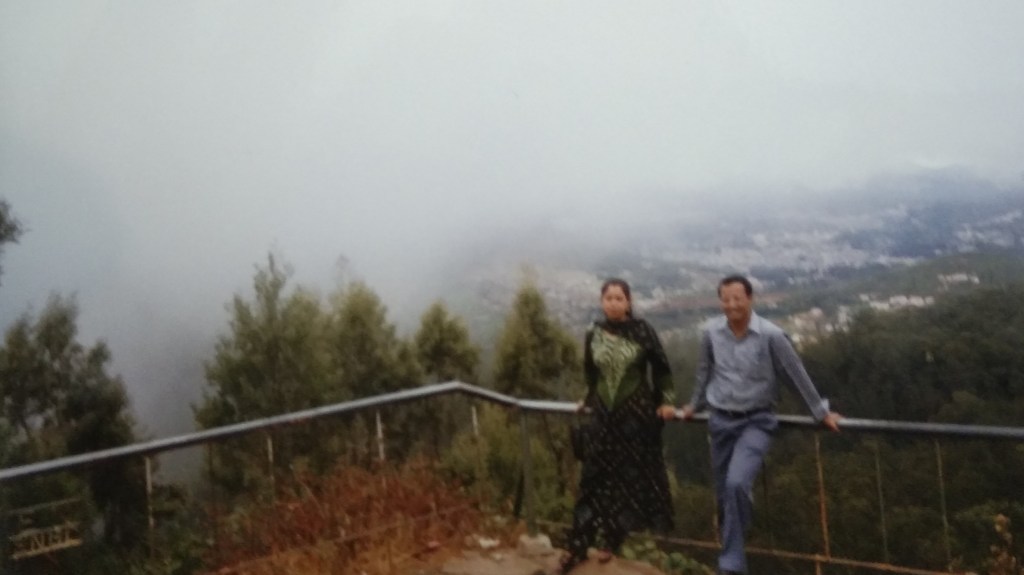
At Ooty
Ooty and Kodaikanal are the two great hill stations in South India that I had been to. The pine forests, lakes, tea gardens and flowers such as rhododendron are great attractions in these hill stations. As I walked by the sides of the lakes, clouds came and engulfed me on all sides. I am yet to experience snowfall for which I have to schedule my visit perfectly.
I spent a few days at Shillong and then Cherrapunjee – the place that receives highest rainfall on earth. The waterfalls in Cherrapunjee that look like white chiffon offer a great view for which tourists throng these places.
Hill stations are the places that restless souls visit for peace and calm. The enormity, stillness and scenic beauty have a quality in themselves that instills sanity and peace into our minds. It provides much needed healing to the wounded souls. Though I have no such need, the trips to the hills have a lasting calming effect on me and I feel like being a permanent resident of the hills so that I can enjoy nature all the time rather than have a slice of it as a tourist.
‘Ee hai Bambai nagariya tu dekh Babua,’ (This is the city of Mumbai, my boy) I crooned to myself as I, along with my family, stepped out of Dadar railway station of Mumbai. That was in 2003 and I was in the city for the first time as we went to visit a relative there. Before that, the city was known to me in those days without internet through glimpses I had of it in Hindi movies, bioscope, postcards of its landmarks and images in newspapers and magazines.
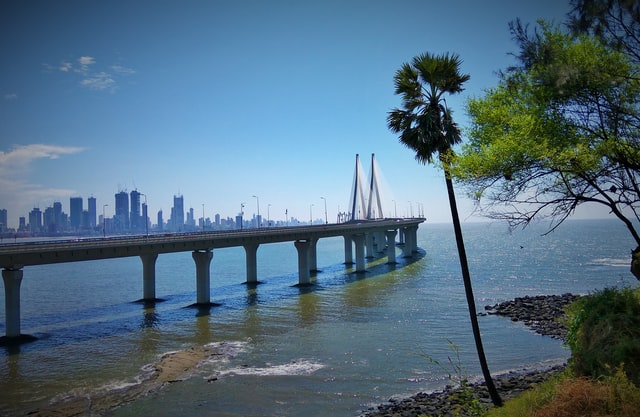
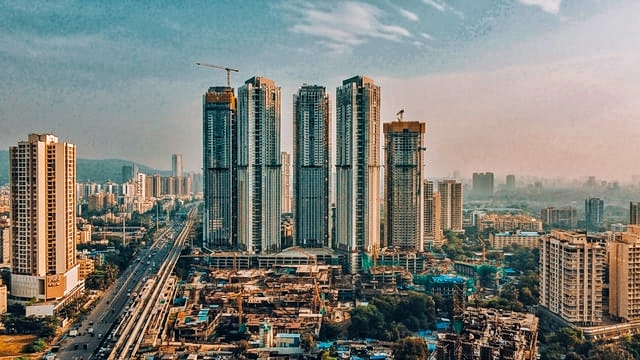
On that visit, I was struck by the city’s skyscrapers, the dizzy heights of which filled me with awe and wonder. No other city in India has them in such heights and numbers! But then the city has sea fronts on its sides. Walking along the breezy Juhu beach and Marine drive relieved me of the dizziness. The atmosphere was relaxing and I promised myself a visit to these spots next time I am in Mumbai.
At Taj Palace Hotel
Mumbai is a city of contrast. The opulence of the billionaires is as much in contrast to the poverty in the slums as the high-rises are to the depth of the Arabian sea. Pomp and splendour coexist with the stench and squalor. Asia’s biggest slum, Dharavy, are there as much as are the castles of industrialists, film stars and cricketer.
But the city welcomes all with a friendly spirit. Ask a taxi driver where he is from. He would probably be from UP or Bihar. The city respects industry and enterprise as also talent in art. If anyone has them, Maya ki nagariya mein Badle jhatpat badle muqaddar ka lekh babuwa (In this city of wealth, writing on one’s destiny changes very quickly), irrespective of who they are and where they are from. Few cities in the world lift one’s destiny the way Mumbai does. There are so many instances of people rising from rags to riches.
The city was a beacon of hope for the educated youth looking for job opportunities. Later IT revolution created jobs in Bangalore, Hyderabad and Chennai and took away much of sheen from Mumbai. But the city still remains a destination for jobs in manufacturing and service as all major industries are headquartered there. Many of my relatives and friends are well settled in the city with jobs, condos, cars and other comforts of life.
The city is overcrowded and space is at a premium. One could see how people squeeze themselves in small compartments, which is not quite living in wretched conditions. They may have willingly embraced this life and are used to it. And who knows some of them might well be living their Mumbai dreams, trying to make it big in some walks of life? We hear stories of people making their beginnings in railway station and footpaths and later becoming successful in music, film, fashion or modelling.
Despite the paucity of space, the citizens of Mumbai zealously protect its green zones and wildlife. Sanjay Gandhi National Park spreads out to a large part of the city and leopards often come into conflict with people living in adjoining areas. Still the support of citizens for the forest and wildlife remains undiminished! Recent movement of Mumbai citizens for protection of Arrey forest is a shining example of their commitment to environment.
I have been to Mumbai many times later for personal and official work. My admiration for the city only grew with those visits and with time watching the way the city responds to situations of celebrations as well as of distress. The city’s legendary resilience enables it to come back to normal life quickly even after very tragic incidents. I had a feel of it when I had to board a train from Mumbai at CST railway station barely a month after 26/11 terror attack.
Trains are the fastest mode of travel in the city. The southern tip where the Gateway of India, Marine Drive and the Taj Palace Hotel are located is relatively calm and less congested. It is the ideal place for tourists to stay and relax with the view of the sea and get refreshed by the breeze from the Arabian sea.
Very often it is only a one-day trip for me to Mumbai and I have to return by the evening flight. Look downward from the flight, the city looks resplendent with lights from streets and high-rise buildings. Surrounded by the sea, the city lights remain concentrated, increasing the brightness of the place at night. I wish that the city retains its virtues and remains bright like this forever. ‘Jai ho Bambai dham ki.’ (Glory to the city of Mumbai.)
I would do it invariably every morning whenever I go home to Maynaguri – be it a day in summer or winter or a day in the rainy season. It is a walk through the path that leads from my home to a nearby village, which takes just a little more than half an hour.
The pathway has on its both sides agricultural fields, ponds, clumps of bamboo, plantations of sal and teak, and hamlets draped in thick foliage of banana, betel vines and all kinds of trees.
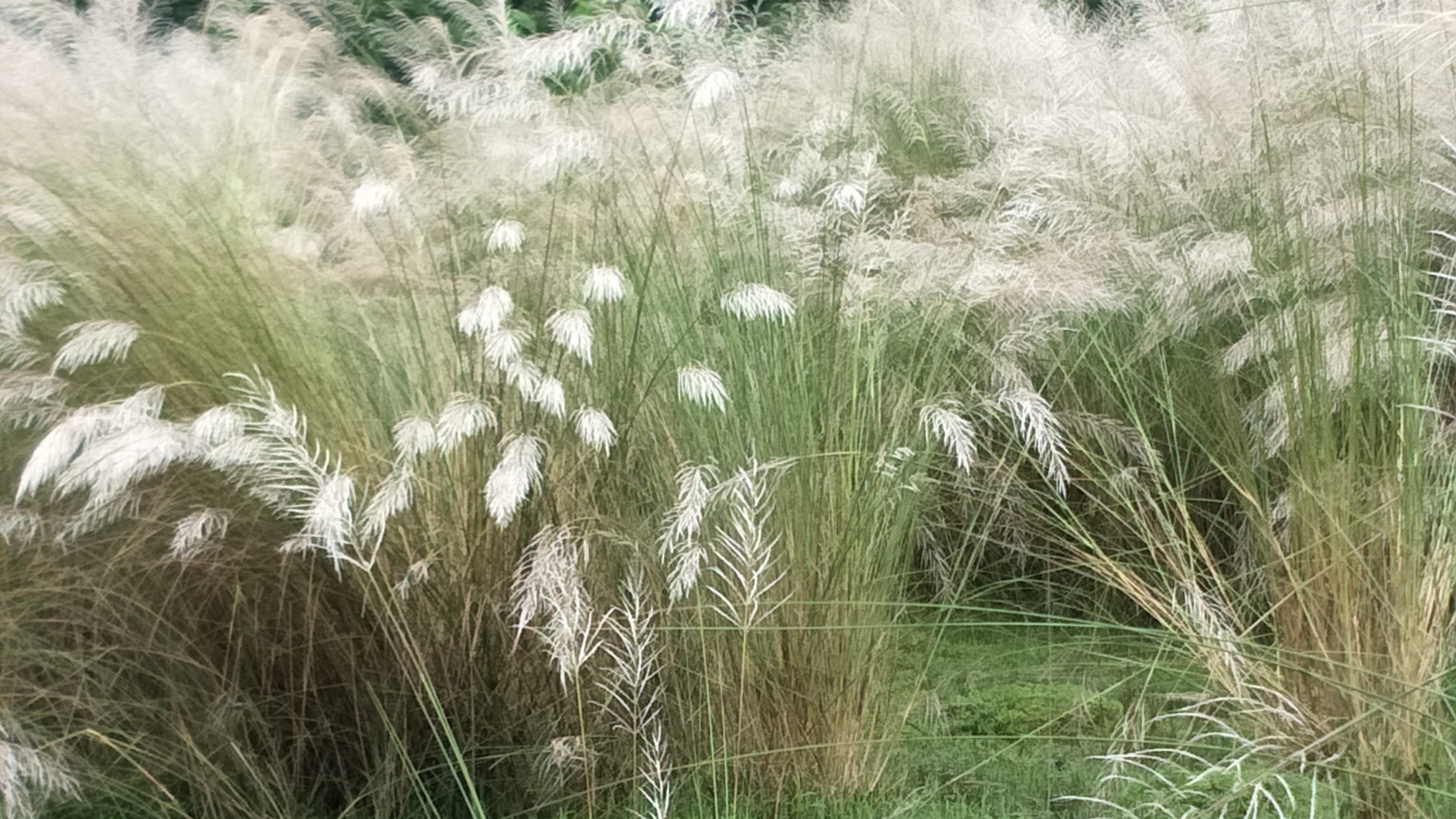
Kash phool on the pathway
Nature assumes wide variety of forms and colour in different seasons, changing from lush green during the rains to golden in winter with paddy covering the fields. My passion for photography only pushes me to go along this path, looking for a scene or a moment to capture in my mobile phone camera.
The people living in the hamlets do not only know me but also have known my parents and grandparents. In villages, people know each other for generations. Now I live in Hyderabad and can visit home only once a year.
Thus, when I come across an acquaintance, they would naturally smile and ask, ‘Oh, you have come.’ ‘Yes, yesterday,’ I would say. ‘For how many days?’ ‘Seven days.’ ‘Only seven days?’ ‘You’re now an officer, doing an important job. You must be a busy man now.’ ‘But you’re free,’ I would say. ‘You don’t need anyone’s permission to go anywhere.’ ‘So how many more years will you be there?’ ‘Still more than ten years.’ ‘You’ll be old by then.’ …
I break into a conversation and ask about their well-being and then take leave. To be recognised on the road by people is a privilege I do not have in Hyderabad.
Again, I tramp and look for something special to feast my eyes on and capture in my camera. Water lilies flower in the pond after it gets filled with water after the rains. In the autumn just before Durga puja, Kash phool (Kans Grass) adorns the fields with their white chiffon like flowers. Bengalis have a deep emotional connect with Kash phool as it heralds the festive season. I look at the flowers for a while and judge the spot and angle for capturing them in my camera.
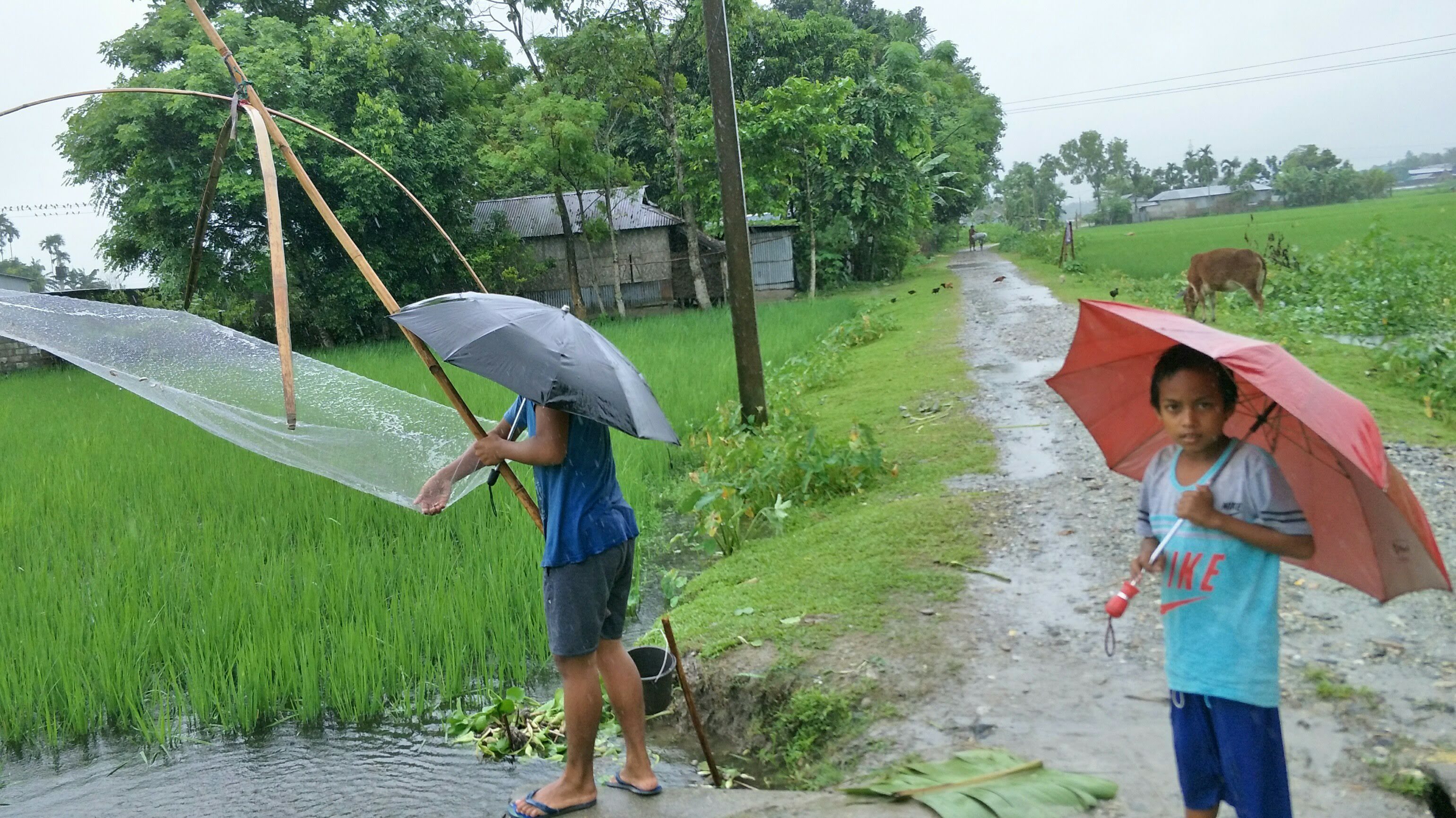
Fishing in the paddy fields
But then there would be a moment which I need to capture immediately, or else the moment would be gone and opportunity missed. In the rainy season, it rains incessantly all day in North Bengal, leaving brief interludes when it would be drizzling.
I go out with an umbrella. As rivers and ponds overflow, fish comes with the flood to the agricultural fields. In those interludes between spells of rains, people come out with nets and fishing rods to catch fish in the streams and the paddy fields with knee deep water. I quickly position myself and take snaps for my recollection of the visit later or a Facebook post for my friends to enjoy the beauty of life in my native place.
After a brief stay at home, I have to return to Hyderabad. I have to wait for a year or so for this pathway to appear in a new form. But what I see year after year and season after season go into my mind’s album, and all the talk I have with people and snaps I get from the walk become a part of my lasting memories.
The scheduled arrival of the train was at 23:50 and the departure at 00:10. That means the train would arrive at the station just before midnight and depart 20 minutes later when it was the start of the next day. In other words, if you are going to the station today, you will board the train tonight and your journey will start in the wee hours of tomorrow. And that is perfectly fine if your ticket is booked accordingly for tomorrow. But if your ticket is for tonight, or to be precise, with journey date of today, alas, your train has already left!
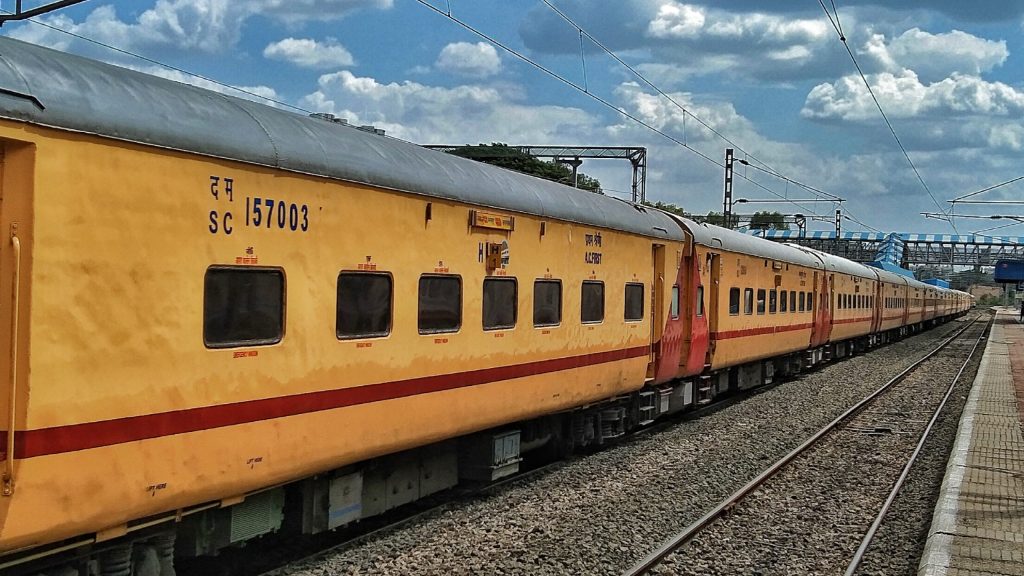
Train in a station – representative image
My train had left thus, and as if that were not enough, I boarded the next day’s train with a wrong ticket! But what happened thereafter was heart-warming for me.
That was in the summer of 2005 when I was on a trip to Nainital for a few days. Travelling from Hyderabad, I, along with my family, had a stopover at Lucknow on the way to the hill station. While departing from Lucknow, a traffic jam on the road delayed our arrival at the railway station, and we boarded the Howrah-Kathgodam Express just a minute and a half before departure without checking the reservation chart for our names.
As the train started, we proceeded to occupy our seats in the Sleeper Class carriage. I saw that two of my fellow passengers had already occupied the berths booked by me. As I asked them to vacate my berths, they showed me their tickets. To my surprise, I found that the seat numbers in their tickets were exactly the same as those of mine.
My mind went blank. It took me some time to realize my mistake – I booked my ticket for 22 June when I should have done it for the next day because my journey was in the early hours of 23 June.
The train picked up speed and the passengers began to settle in their seats. With my wife and two-years old son journeying along with me, I could not afford to get off the train at the next station. I got a little panicky. I showed my ticket to some of my co-passengers and asked whether I would be allowed to travel with that ticket. They said, ‘Aapke pas ticket hai na? Kyu nehi allow karega? (You’ve the ticket. Why won’t they allow you?)’
But the prospect of making a 10-hours long journey at night along with a kid, standing or sitting, filled me with anxiety. Sensing my distress, one of them assured me, ‘Please be seated. We’ll have some arrangements for you shortly.’
They were a large group of men and women travelling together by the train that night. Almost half an hour later, one of them called me over and mentioned two seat numbers for us. Two women of the group magnanimously vacated their berths and accommodated themselves elsewhere along with their children.
I cursed myself for not being careful enough about my itinerary and was getting ready to offer an explanation to the ticket examiner, pay a hefty fine or just be scolded by him. However, he did not come to check the tickets after midnight.
It is almost sixteen years since then and I have had my share of unanticipated troubles in the travels afterwards – my illness, a sudden call of strike by localites, vagaries of the weather, cancellation of train and all that. Those are, however, the hassles that come with travelling and I was prepared for them. But some troubles cannot be overcome without the help of others and one cannot be grateful enough when help comes from the strangers. In this context, this act of kindness by my fellow passengers sixteen years back still moves me. And it reaffirms my faith in the goodness of people and makes me go out into the world with confidence.
The many bus journeys I made during my college days for going home were largely safe and incident free. So, I hardly had any foreboding of something horrific happening to me while on a trip home on a night of winter in 2002. I studied engineering at Bengal Engineering College at Shibpore, Howrah, from where I used to go to Esplanade to board a bus to Siliguri in the evening. A 14-hours journey up to Siliguri and beyond would then take me to my hometown, Maynaguri, by the next morning.
Then as a college student, it was usually during summer and puja vacations that I used to go home. But this time, a few unexpected holidays in December made me homeward bound. As usual, I boarded a bus to Siliguri at Esplande bus stand. I still vividly remember that it was a cold night, making the passengers in the Volvo Bus sit in their seats, wrapped in warm clothes. The bus made a pit-stop at Krishnanagar, 100 km away from Kolkata, where we had dinner, and then left for the destination. I closed my eyelids, but the glare of headlights of the buses coming from the opposite direction fell into my eyes now and again, keeping me awake. I tossed and turned in my seat for some time and eventually drifted off to sleep.
It was about two o’clock. I was suddenly jolted out of my sleep! Some men were beating at the bus and shouting, ‘Grab them, hit them.’ Before I could make out anything, three or four of them, their faces covered with clothes, barged in to the bus through the door in the front, brandishing knives and pistols. The driver and conductors rushed to the back, fearing for their safety! I realized that the men were dacoits out to rob us of our belongings. They started lifting the bags and suitcases stowed in the shelves above the passengers’ seats. A man in the front row tried to prevent a dacoit from taking away the suitcases. What the robber did immediately still sends shivers down my spine! He swung his knife, nicking the man’s chin, thus making his intentions clear!
The robbers shouted in Hindi, ‘Kagaz Nikal (bring out your notes).’ Then they went about extorting money from the passengers. Seated by the window in one of the middle rows, I kept a bag in the aisle. I lifted it and stowed it below the seat in front of me. And as they came in, I brought out two hundred-rupee notes from my wallet and stretched my hand with the money towards them, apprehensive about their being satisfied with the offer. But to my relief, one of them collected it and hurried towards the back rows. They did not ask for more!
The robbers went about terrorizing passengers with knives and pistols and extorting money. But all of a sudden, a whistle was heard! A train was coming through the track that ran parallel to the bus route. The robbers seemed very worried! They screamed, ‘Train! Train!’ and rushed to the door! All of them got off the bus in a jiffy and went away as the train whizzed past us. The passengers in the bus heaved sighs of relief!
Our bus went to a police station near Farakka to register an FIR. And after registering the FIR, which took almost three hours, we left for Siliguri. It was in the evening that day as opposed to the morning usually that I reached home. The robbers were armed with knives and pistols, and the robbery happened all of a sudden when the passengers were asleep. But the train came to our rescue! What frightened them, I still do not know. Did they fear that the train would stop and people would go after them? Maybe they were afraid. But thank God the train came to our rescue at the right time that night!
Should our dream destination always be far away from home? Minds wander away from our horizons into distant islands and continents. Yet, the locations within our vicinity may hold the thrill and wonder not to be found elsewhere in the world! I realized this to my surprise when I visited Jaldapara forest close to my home last month. My wanderlust has taken me mostly to far-off destinations, as though anything worth seeing must reside in distant places beyond my reach. But now a trip to the forest has so thrilled me with the view of nature and wildlife that I am left wanting to visit the jungle again and again.
Jaldapara is a deciduous forest in the floodplains of Himalayas and is home to India’s second largest population of one-horned rhinos after Kajiranga. It is a forest of mainly sal, teak and mahogany trees standing tall and forming thick foliage with a canopy at the top. Inside the forest, there is a quaint bungalow for the tourists to lodge in. This is Hollong Forest Bungalow. Accommodation in the bungalow is limited and tourists have to book rooms well in advance.
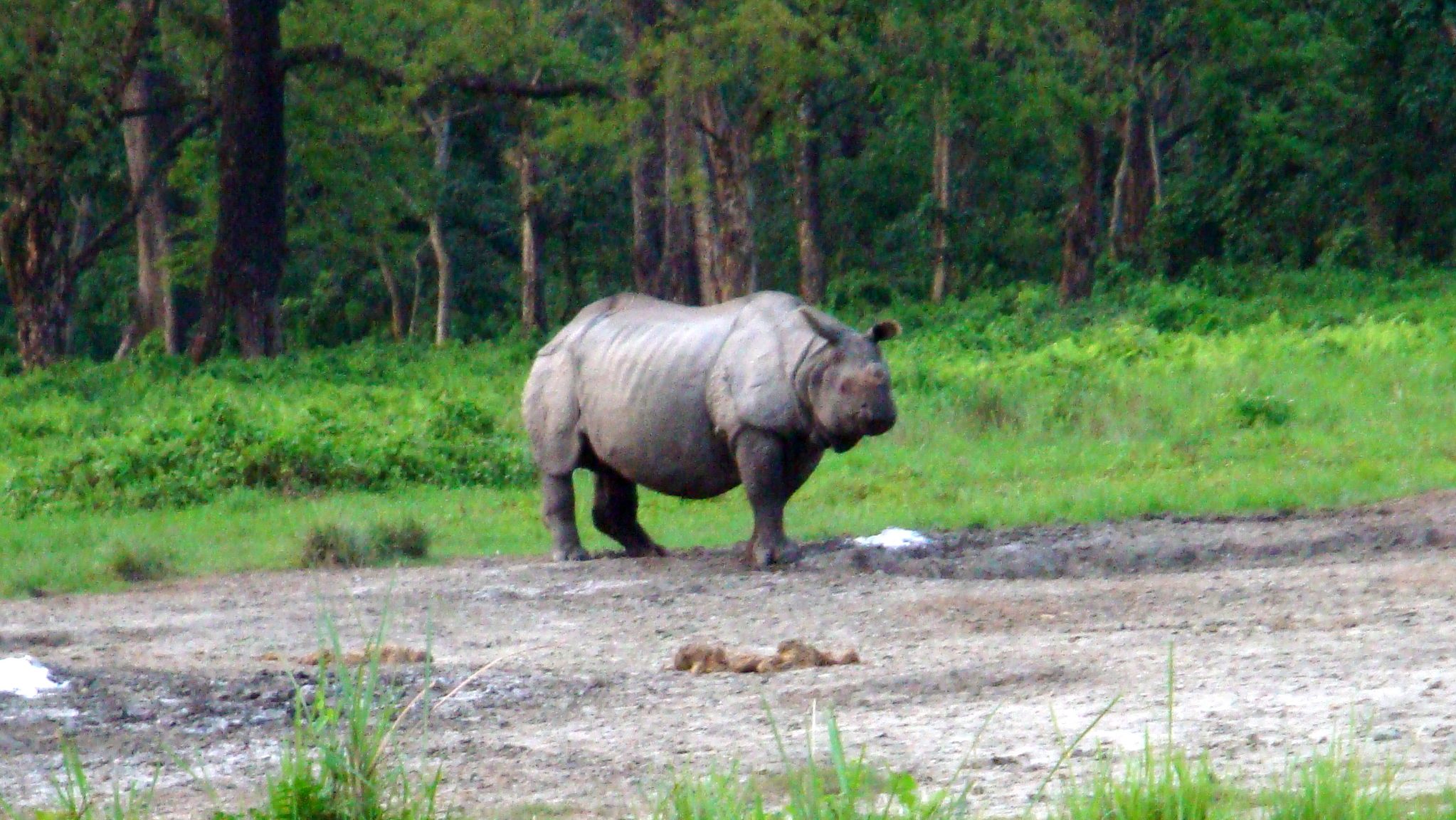
I, along with my family, set off early in the morning. We reached the forest, which is 80 km away from my hometown, Maynaguri, in just over two hours. The entrance to the forest is on the highway connecting Jalpaiguri with Alipurduar and the lodge is eight km inside. As we drove towards the lodge, we peered into the jungle on both sides of the approach road for wild animals. Was something stirring in the bush? Rhinos are sedentary animals and can be sighted easily. Finally, there it was! A rhino resting under a tree as we came near the lodge – a huge animal with a horn that would give anyone a scare! Our car stopped for a while for us to take some snaps. Then, within a minute, we were at the lodge.
Hollong bungalow
Hollong tourist bungalow is a two-storey wooden house with five rooms, and around it are forest offices, cottages for foresters and a temple. The lodge overlooks a vast stretch of grassland surrounded by tall trees standing like walls on all sides. An attendant helped us check into the room named Kingfisher in the second floor. Opening the window of Kingfisher, we were thrilled to get the bewitching view of the grassland! There is a stream nearby and on the other side, a clearing made by removing the grass cover. The attendant told us that there was a salt pit in the clearing and animals frequented the spot to taste the salt, which was replenished by the staff of the lodge every morning.
I went near the stream, where tourists thronged to behold the scenic beauty of the jungle. Everyone was expecting to see some wild animals present themselves at the clearing. And they were not to be disappointed! Two bisons were soon seen coming out of the woods and tiptoeing towards the salt pit! I never knew that the taste of salt could be so enticing that they were ready to risk being sighted by people! But their wide open eyes and taut ears were indicating their alertness – the slightest hint of trouble was sure to make them run away to the safety of jungle. Then came a sub-adult rhino. Young and inexperienced, it stood there with its head down, relishing the salt, and looked up from time to time, giving the tourists the opportunity to have some good shots from a close distance.
Rhino in front of tourist lodge
The silence of the forest was seeping into my mind and soul. The cacophony of urban life makes us oblivious to the sounds of nature. But there the tranquility of the place aroused my alertness to the sound of breeze and the rustle of leaves. As daylight dimmed, birds started warbling and in the twilight, the atmosphere was filled with the song of birds. Suddenly, I noticed a rhino just at the gate of the tourist lodge. I was horrified, but was told that rhinos roam freely around the lodge at night.
We had a decent meal in the restaurant of the lodge. Returning to the room, we sat near the window and looked out towards the salt pit for more inhabitants of the forest. We stayed up till midnight as the staff of the lodge kept focusing their searchlights on the animals visiting the spot. A herd of chital was there and so also a herd of bison for a pinch of salt!
After a good night’s sleep, we woke up early in the morning to go for the elephant safari. There are four elephants for the safari. One has to climb the elephant’s back through a ladder and a platform. Guided by mahouts, four of us rode one of the elephants and left for the safari. As she ambled gracefully through the jungle, the mahout sitting in front of us kept putting aside the branches dangling from the trees along the way. He was raving about his skills as a mahout, the elephants he cared for and about how once chased by a rhino he took the tourist back to safety.
There are several streams crisscrossing the forest. The elephant dutifully crossed two of them with the load of five of us on her back. While crossing the stream, she drew water through her trunk, quenched her thirst and moved on. She entered the grassland that stretched far from the tourist lodge. And what variety of grass there was! Tall and bushy with blades spread like a fountain of water! It was elephant grass. We explored the pasture for a while. Then the mahout guided her back to the lodge, and the safari was completed within one and a half hours.
I wanted to spend one more night at the lodge. But, alas, my booking was for only one night! So it was time to pack up and return. It was drizzling and a cool breeze was blowing. The attendant came and put our luggage in the car. We had another look at the clearing and, while driving away, took some more snaps to treasure the memories of the trip for the future. We left with a desire to visit the place once again.






 Trickles of Tales