Harvesting A Windfall

If you had an unlimited budget for 24 hours, what would you do?

A windfall often goes waste because one has not anticipated it nor planned for its use. Having an unlimited supply of money to spend in 24 hours could suddenly make one tizzy like a befuddled rat.

I am no expert of money, but I know that money can be more fluid than air or even water. If not restricted, it can just gush out in a torrent and make the source dry just in a moment. It can go down the drain or create wealth for use in the future.

Money (pc : http://www.unsplash.com)

Many things that we want to do in life remain undone because of the lack of money. I want to build a hospital in memory of my mother and a school. In 24 hours, I could perhaps enter into an agreement to buy pieces of land available on sale in my home town and make payment immediately. I could build a hospital later on one of them and sell the rest to generate funds for infrastructure, medical equipment and employment of doctors and nurses. The same would be for building a school as well

Of late, l have developed an interest in photography, which is an expensive hobby. I have a Nikon camera. I would like to buy all the gears such as long lenses, tripod and ND filters for this camera and a camera of a different brand.

If I could do this, I would believe I have utilised the windfall in a short time.

A Kid’s Obsession

What’s a thing you were completely obsessed with as a kid?

Innocent about the ways of the world, a kid tries to explore it through anything they see in front of their eyes. With a bundle of energy, a kid would naturally be drawn to things that are in the domain of their elders and are dynamic.

Of the many activities I was obsessed with, the thing that I remember most is cycling. In the nineteen-eighties, people in the villages of India mostly had bicyles as vehicles for commuting short distances. My father did not use any bi-cycle while my uncle was always on the move with his one.

Good old day’s bicycle (pc: http://www.unsplash.com)

Luckily I found a bicycle in my neighbour’s home, which used to remain idle most of the time. Every morning after my studies, I used to take the bicycle and simply walk it from one home to another. It was a kind of obsession I could not get over and became a daily routine. I was still not able to ride it as that would require me to be tall enough to be able to be seated with my legs reaching the ground. Also it needed training and physical balance.

Later slowly I learnt to ride half pedal. I reached the pedal on the other side by putting my right leg across below the cross bar. Riding half pedal was enough for me to go around my village.

It was many years later when I grew up that I learnt to ride a bicycle. But I remember those days when I used to simply walk it. That  activity kept me engaged and gave me a lot of fun.

Rangoli – A Pattern of Custom

What’s the most interesting local custom you’ve encountered?

Customs are an essential part of variegated cultural life in India. In this country of gods and goddesses, customs originate mainly from the religious practices of Hinduism. The daily routines of men and women are informed by these very customs.

I saw my mother wake up early in the mornings, take bath and workshop God. Again after sunset, she would light lamps before the idols. It brought a kind of order and routine with which she spent her entire life.

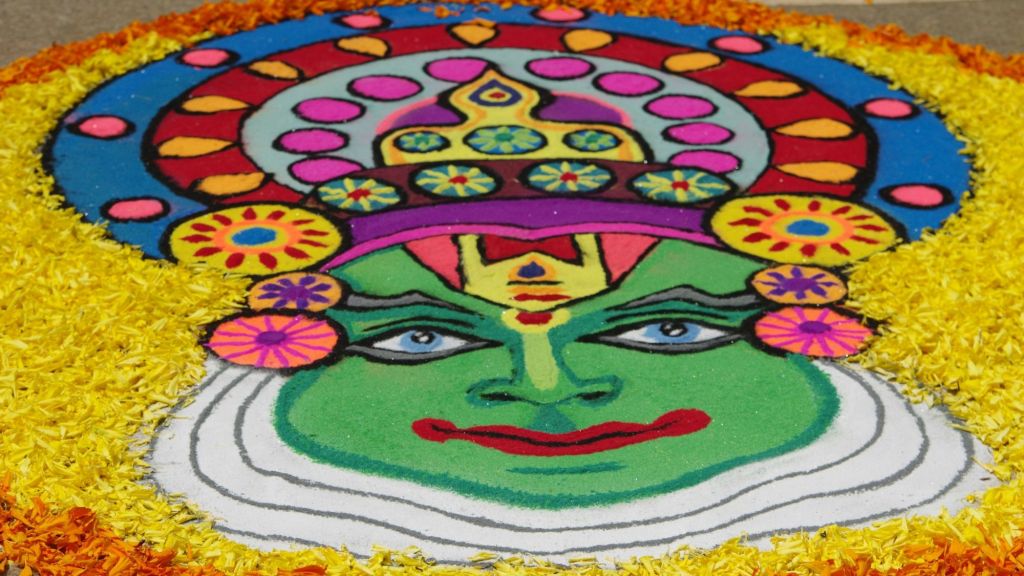
Rangoli – the face of a Kathakali Dancer (pc: http://www.unsplash.com)

I have spent a long time in the southern part of India. One custom that strikes me is Rangoli. Women decorate their door steps by drawing patterns every morning with coloured powders.The creative patterns are the marks of taste of the householders and make the first good impressions on the visitors. If one passes by the household, they feel welcomed by it.

Then the next morning, again they wash the floor and decorate it with a new pattern. Rangoli is a positive start of activities for them every day.